

> Cognitive behavioral therapy for aviophobia is a short-term, structured treatment that identifies catastrophic flight-related thoughts and avoidance patterns, then replaces them through evidence-based cognitive restructuring and systematic exposure to flight cues.
- CBT targets the specific fear driving your aviophobia, crashing, panic, claustrophobia, or loss of control, not just generic anxiety.
- Treatment combines thought challenging, aviation psychoeducation, and a graded exposure hierarchy from plane photos to real flights.
- Most CBT programs for flight anxiety run weeks to a few months, with lasting results that medication alone cannot match.
What CBT For Fear Of Flying Actually Treats
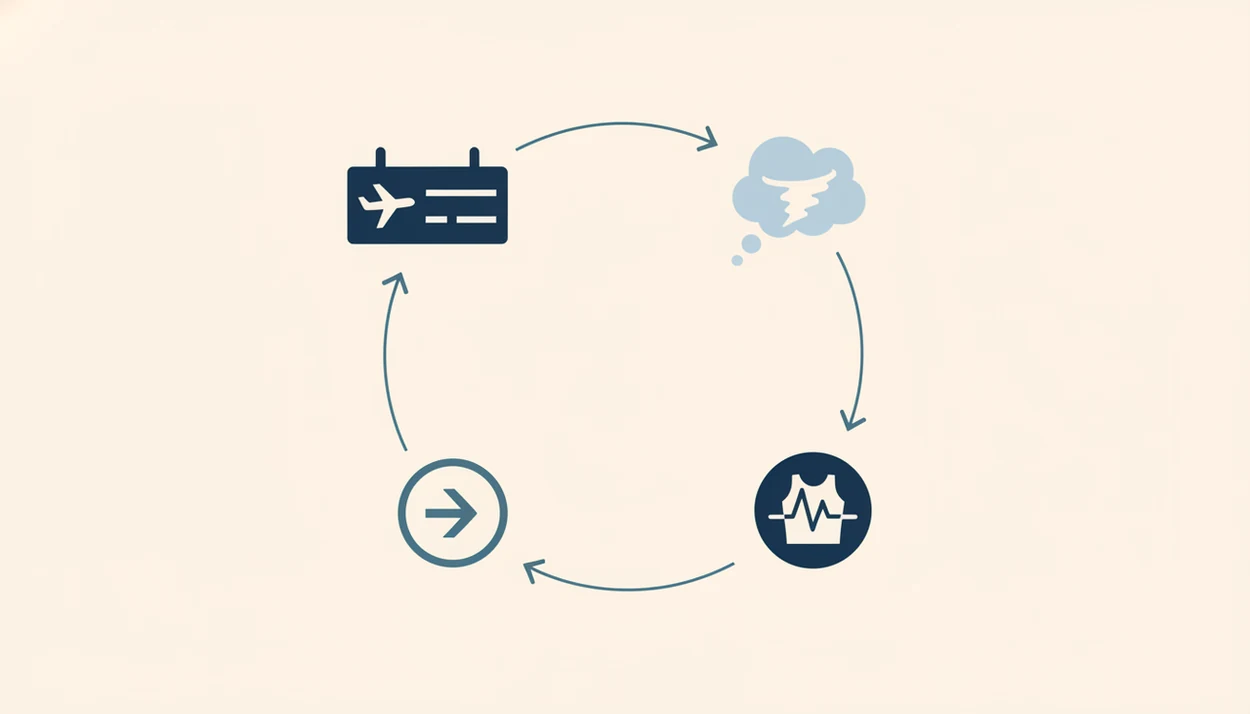
CBT for fear of flying treats the specific fear cycle behind aviophobia, not a vague dislike of airports. The target changes depending on whether your main fear is crashing, having a panic attack mid-flight, claustrophobia, loss of control, contamination, terrorism, or being unable to escape.
A typical CBT map looks like this: trigger, catastrophic thought, physical anxiety, avoidance. The gate screen changes to delayed boarding. Your thought says, “Something is wrong with the plane.” Your chest tightens, your mouth dries, and you start planning how to leave.
That loop is the treatment target.
In a nationally representative U.S. survey, about 40% of adults reported some fear of flying, and 12.6% reported extreme fear; cite the original survey or dataset here with a direct source URL. Clinicians typically recommend CBT as a first-line treatment for specific phobias because it changes the learned fear pattern. Medication may reduce symptoms for one flight, but it usually does not retrain the phobia.
A good fear of flying resource should explain causes, treatments, coping strategies, and tools for nervous flyers, not just hand you a breathing exercise and call it solved.
Five Evidence-Based Facts About Flight Anxiety CBT
- Flight anxiety CBT combines thought work with graded exposure. You challenge predictions like “the wing will snap” while gradually facing flight cues, from photos to real boarding.
- Aviation psychoeducation is part of treatment. Normal sounds, banked turns, engine changes, and turbulence feel less threatening when you know what they mean. The drink ripples on the tray table; that does not mean the aircraft is unsafe.
- Relaxation tools can help, but they can also become safety behaviors. Breathing, music, or grounding should support exposure, not become the only reason you believe you survived.
- CBT is usually time-limited. Many programs last weeks to a few months, depending on severity, access to flights, and how often you practice between sessions. The CBT for fear of flying timeline explains that pacing in more detail.
- Virtual reality and simulators can substitute for early real-flight exposure. A meta-analysis of 33 randomized controlled trials found a large CBT effect for specific phobias, with Hedges g about 0.80. According to a Cochrane review, CBT also shows higher remission rates than no treatment or placebo across anxiety conditions, including specific phobia. Source: https://www.cochranelibrary.com/cdsr/doi/10.1002/14651858.CD013162.pub2/full. This evidence is broader than fear of flying alone, so it should be treated as support for CBT across anxiety conditions, not as aviophobia-only proof.
Who CBT For Fear Of Flying Is Best For
CBT for fear of flying is usually the best fit when the problem is avoidance, catastrophic predictions, panic fear, or a strong need to stay in control. It is especially useful when you can practice facing flight cues instead of only trying to calm symptoms.
Use this quick fit check before choosing self-help, therapist-led CBT, or a combined plan:
- Choose self-guided CBT if your anxiety is mild to moderate, you still take most planned flights, and you can practice with videos, airport visits, or short routes without repeatedly canceling.
- Seek clinician-led CBT if you have trauma memories, severe panic attacks, substance use around flying, or a pattern of booking and backing out. The same exposure tools can still work, but the pacing and safety planning need more support.
- Treat medication as support, not the whole plan. A prescribed medicine may reduce symptoms, but it usually does not replace the learning that happens when you face flight cues and discover your feared outcome does not occur.
- Use VR or simulator practice when real flights are too expensive, too rare, or too far away. These tools can make the middle steps less all-or-nothing.
How Cognitive Behavioral Therapy For Aviophobia Works
CBT works by changing the meaning your brain assigns to flight cues, then testing those new meanings through exposure. Two models matter here: habituation, where distress drops with repeated contact, and inhibitory learning, where your brain learns “I can feel fear and still be safe.”
Cognitive Restructuring Of Catastrophic Flight Thoughts
Cognitive restructuring means you catch the automatic thought, test it, and replace it with a realistic appraisal. “The plane will crash” becomes “Turbulence is uncomfortable, but aircraft are built to tolerate it.” Per the National Safety Council's Odds of Dying estimates, the lifetime odds of dying in air or space transport are about 1 in 11,157, compared with 1 in 93 for motor vehicle accidents: https://injuryfacts.nsc.org/all-injuries/preventable-death-overview/odds-of-dying/.
Use the Notes app before you open the airline app. Write one feared prediction, one aviation fact, and one action for your next five minutes.
How Graded Exposure Retrains Your Threat Response
The behavioral part is repeated exposure without escape. Plane photos, airport sounds, jet bridge practice, and short flights teach the nervous system that the predicted catastrophe does not occur. For many people, exposure therapy for fear of flying is where CBT becomes practical instead of theoretical.
The most common medically supported way to reduce a specific phobia is CBT combined with gradual exposure to feared cues.
Before You Start CBT For Fear Of Flying
Before you start CBT for fear of flying, define what kind of fear you are treating and how much support you need. A mild fear before vacation is a different starting point from panic attacks, trauma memories, repeated cancellations, or drinking just to board.
- Name your fear pattern. Decide whether the main issue is mild discomfort, severe avoidance, panic-linked fear, trauma-linked fear, claustrophobia, loss of control, or fear of crashing.
- Choose one realistic target. Pick an upcoming flight or a practice substitute, such as watching takeoff videos, visiting an airport, using VR, or booking a short route instead of a long-haul test.
- Rate your baseline anxiety. Use SUDS from 0 to 100 before building the hierarchy, so you know which steps are challenging but not overwhelming.
- Avoid exposure crutches. Do not rely on alcohol, unprescribed sedatives, constant reassurance, or flight tracking as the reason you get through practice. If medication is prescribed, use it only as directed.
- Decide when to get therapist help. Choose therapist-led CBT if fear is severe, panic attacks feel unmanageable, trauma is involved, substance use is part of flying, or self-directed exposure keeps ending in escape.
How To Use CBT For Fear Of Flying: Step-By-Step
Use CBT as a flight-day plan, not as a last-minute rescue trick. A therapist can guide the sequence, but self-directed workbooks may help mild cases if you practice consistently.
- Identify your core fear theme. Name the main fear: crash, panic, claustrophobia, loss of control, contamination, or terrorism.
- Log automatic thoughts and body sensations. Write what happens when you see a boarding pass in Apple Wallet, hear engines spool, or imagine the cabin door closing.
- Challenge each catastrophic thought. Pair the fear with aviation facts, probability evidence, and a calmer replacement thought you can actually believe.
- Build a personal exposure hierarchy. Move from plane photos to videos, airport visits, simulator practice, a short flight, and then a longer flight.
- Work through the ladder while dropping safety behaviors. Reduce armrest gripping, repeated flight-tracker checking, alcohol, or only flying with one trusted person.
- Review progress and schedule maintenance exposures. After landing, note what you predicted, what happened, and what to repeat next month.
Make the plan boring on purpose. Tools like Fear of Flying Guide, flyconfident.com, and SOAR can help organize practice, but the useful part is the repeated behavior change.
Safety Behaviors That Undermine Flight Anxiety CBT
Safety behaviors are actions that make you feel protected but stop your brain from learning that flying itself was safe. Common examples include lucky charms, constant flight-tracker checking, pre-flight sedatives or alcohol, gripping the armrests, or only flying with one specific companion.
The tricky part is that these habits feel reasonable in the moment. Your thumb traces the armrest seam, your shoulders lock, and your brain says, “Do not let go.” But if you believe you coped only because you gripped, checked, drank, or escaped, the phobia stays in charge.
CBT identifies these behaviors and reduces them slowly. Relaxation techniques count too if they are used to avoid feeling any anxiety. Breathing is useful when it helps you stay present. It becomes a problem when it turns into a rule: “I must breathe perfectly or I am not safe.”
Building A Fear-Of-Flying Exposure Hierarchy In CBT

A fear-of-flying exposure hierarchy is a ranked practice ladder using SUDS, or Subjective Units of Distress Scale, from 0 to 100. You rate each flight cue by how anxious it makes you, then practice from easier items toward harder ones.
A sample hierarchy might look like this:
| Exposure step | SUDS rating |
|---|---|
| Look at plane photos | 20 |
| Watch cockpit videos | 35 |
| Visit an airport observation deck | 50 |
| Use VR flight simulation | 65 |
| Board a grounded plane | 75 |
| Take a short domestic flight | 85 |
| Take a solo long-haul flight | 95 |
The point is measurable progression, not bravery theater. If a VR cabin scene gets you to 65 SUDS, stay there until your predictions weaken. Then move up. For people without easy airport access, virtual reality exposure therapy flying can fill the middle of the ladder.
For nervous flyers, graded exposure is often easier than forcing one major flight because each step creates a smaller learning target.
Common Myths About CBT For Fear Of Flying
Myth 1: CBT is just positive thinking. Reality: CBT tests thoughts against evidence and changes behavior. “Planes are safe” is not enough if you still avoid every flight cue.
Myth 2: CBT only teaches coping. Reality: controlled studies of specific phobias show large fear reductions, especially when exposure is included. The practical question is not only “does CBT for fear of flying work,” but whether the treatment includes real practice with flight triggers. The evidence question is covered more directly in does CBT for fear of flying work.
Myth 3: Medication alone is the best fix. Reality: medication may help short-term symptoms, but it does not usually update the learned fear of flying.
Myth 4: CBT cures the fear forever. Reality: relapse can happen. Maintenance matters, especially after a long gap between flights.
Pack this before you leave: a coping card, gum in the front pocket, and one exposure goal for the airport.
Limitations
CBT is evidence-based, but it is not magic. It asks you to face flight cues, and that is the part most people want to skip.
- CBT requires willingness to approach feared stimuli. Avoiding exposure usually limits progress.
- Fewer randomized trials focus only on aviophobia than on specific phobias as a broader category.
- Long-standing flight fear often needs multiple sessions, homework, and planned practice flights.
- Severe depression, PTSD, substance misuse, or panic disorder may need modified treatment.
- Access to therapists trained in flight phobia CBT can be limited outside major cities.
- Some exposure steps cost money, especially airport visits, simulators, VR tools, or practice flights.
- Sedatives and alcohol can interfere with learning if they become the reason you believe you coped.
- Self-help tools can support practice, but severe avoidance is usually better handled with a clinician.
Apps such as Fear of Flying Guide on FearOfFlying.com can support planning, but they do not replace diagnosis, therapy, or medical advice.