
How to Practice Flight Exposure With Phone Tools
To learn how to practice flight exposure with phone tools, build a gradual ladder of flight cues on your smartphone, repeat each step until anxiety rises and falls, and track your ratings without turning the phone into a reassurance-checking device.
Definition: Phone exposure for fear of flying means using smartphone sounds, videos, images, notes, reminders, maps, and structured apps to rehearse safe flight cues before a real trip.
This guide is educational and is not a substitute for care from a licensed mental health professional, especially if flying fear is linked to panic attacks, trauma, medical anxiety, or repeated trip cancellation.
TL;DR
- Start with easy cues such as plane photos or airport maps, then move toward takeoff videos, cabin sounds, turbulence clips, and full trip simulations.
- Use 0–10 anxiety ratings before, during, and after each practice so you can see whether fear drops without escape or reassurance checking.
- Avoid crash videos, compulsive flight tracking, endless safety research, and stopping every exposure at peak fear.
Flight exposure with phone tools: what counts as practice
Phone-based flight exposure is planned contact with realistic flight cues, not random scrolling about planes. It uses safe, ordinary material: plane photos, airport videos, takeoff audio, turbulence videos, seat maps, boarding passes, flight apps, and notes.
Crash compilations are not practice. They train your threat system on rare disaster images, not normal flying.
A real session might mean opening a saved boarding pass in Apple Wallet, listening to cabin noise for 12 minutes, and writing one learning statement afterward. Calming music, games, and scrolling can help you pass time, but they don't create the same learning as staying with the flight cue. Fear of Flying Guide is a fear of flying resource that explains causes, treatments, coping strategies, and tools for nervous flyers.
How phone exposure for fear of flying works in the brain
Exposure works through inhibitory learning: your brain predicts danger, stays with the cue, and learns a new message. “This feels unsafe, but I can remain here without escaping.” Clinicians typically recommend exposure as part of CBT for specific phobias, often alongside realistic thinking and body skills.
For the mechanism, cite the inhibitory-learning model of exposure therapy from Craske et al. (2014) (https://doi.org/10.1016/j.brat.2014.10.006), and cite NHS phobia treatment guidance for graded exposure/desensitisation as a standard phobia treatment approach (https://www.nhs.uk/mental-health/conditions/phobias/treatment/).
- The brain treats flight cues as warnings before it has proof of actual danger.
- Repetition matters more than intensity because learning needs repeated mismatch.
- Phone practice lets you rehearse takeoff sounds, cabin images, and body sensations before travel day.
- CBT adds aviation education, thought testing, breathing, and planned behavior change.
- Research on computer-based and virtual reality exposure suggests technology-delivered exposure can help phobias, including fear of flying.
The most common medically supported way to reduce phobic avoidance is exposure practice combined with CBT skills, not reassurance alone.
Evidence Behind Phone Exposure for Fear of Flying
The evidence is strongest for exposure therapy as a treatment principle for specific phobias, and more cautious for phone-only practice. A phone can deliver useful cues, structure, and repetition, but it does not turn a self-guided session into full therapy.
Clinical guidance for phobias commonly describes graded exposure or desensitisation: approaching the feared situation in planned steps until the brain learns that avoidance is not required. Research on computer-based and virtual-reality exposure suggests technology can help create realistic practice conditions, including for flying fears, but those findings do not prove that every app, playlist, or turbulence clip is clinically tested.
Use the evidence in a practical way:
- Build a ladder from easy flight cues to harder ones, so practice is challenging without becoming chaotic.
- Repeat sessions because learning usually comes from several safe encounters, not one dramatic push.
- Prevent escape habits such as pausing, muting, reassurance texting, or checking flight data when anxiety rises.
- Track progress with start, peak, and end ratings plus one learning statement.
- Get support if panic, trauma, or cancellations keep overriding the plan.
Think of phone exposure as an adjunct: useful rehearsal between sessions, not a replacement for licensed care when fear is severe.
Phone exposure for fear of flying requirements before you start
Set up the phone before your anxious brain starts negotiating. Do it before you open the airline app for the fifth time.
- Notes app coping card: Write the cue, your 0–10 ratings, and one realistic statement.
- Two-minute timer plus session timer: Use one timer for breathing, another for the full 10–20 minute practice window.
- Headphones: Save cabin noise, engine sounds, announcements, and turbulence audio.
- Realistic content folder: Choose normal airline, airport, cabin, and takeoff sources.
- Safety boundary: Don’t practice while driving, at work, or anywhere panic would create risk.
Make the plan boring on purpose. A half-charged phone and tangled headphones are enough if the structure is clear.
How to use your phone for flight exposure practice
Use one small job for your body, one cue for your brain, and one log entry. Don't turn the session into research.
- Set one flight cue for the session. Pick one saved photo, sound, video, seat map, or app scene.
- Rate anxiety from 0–10 before starting. Put the number in your Notes app without explaining it.
- Play or view the cue without pausing, checking, or switching apps. Keep your feet flat and your eyes on the chosen cue.
- Stay until anxiety peaks and begins to reduce, or until the planned time ends. If the drink ripples on the tray table in a turbulence clip, keep watching.
- Log the ending rating and one realistic learning statement. Example: “My body surged, then settled, and I stayed.”
For many nervous flyers, short repeated phone sessions are easier than one long practice block because the brain gets more chances to relearn.
Step 1: Build a phone exposure ladder for fear of flying
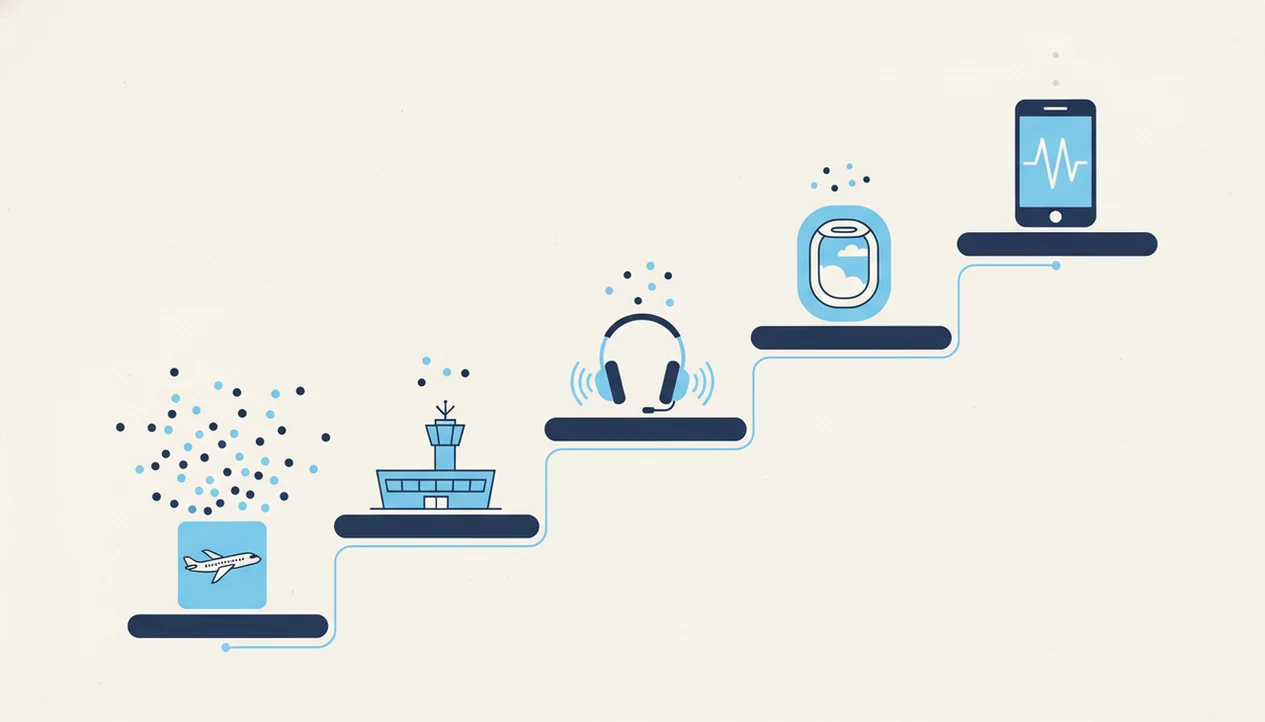
A phone exposure ladder orders flight cues from mildly triggering to strongly triggering. Rate each item 0–10 first, then sort the list. Rushing to the hardest clip can backfire and make avoidance look sensible.
| Ladder item | Example phone cue | Typical intensity |
|---|---|---|
| Plane photo | Saved image of an aircraft | 1–2 |
| Airport map | Terminal map for your airport | 2–3 |
| Gate video | Calm airport waiting clip | 3–4 |
| Boarding video | Jet bridge or boarding scene | 4–5 |
| Cabin walk-through | Seat and aisle video | 5 |
| Taxi audio | Engine and runway sounds | 5–6 |
| Takeoff video | Full takeoff from seat view | 6–8 |
| Turbulence audio | Cabin bumps and announcements | 7–8 |
| Full simulation | Airport-to-landing sequence | 8–9 |
If you want the clinical version, exposure therapy for fear of flying uses the same ladder logic with more support.
Step 2: Practice flight sounds and videos without escape habits
Flight sounds and videos help only if you stay with them long enough for anxiety to move. Avoid stopping at the most anxious point, because that teaches your brain that escape caused relief.
Use headphones for cabin noise, engine spool, safety announcements, takeoff roll, and turbulence clips. Put the phone down if you can, so you’re not hovering over the pause button. Damp fingers on the safety card are normal in the real cabin; sweaty palms during a video are not failure.
Watch the escape habits: pausing, muting, switching apps, texting “I can’t do this,” searching crash statistics, or checking aircraft models. Pick one rule: no switching until the timer ends.
Step 3: Mirror your upcoming trip with phone tools
Does phone exposure work better when it matches my actual flight? Yes. Matching the real sequence helps practice transfer from the phone to the airport.
Build a folder or playlist in order: booking email, packing reminder, ride to airport, terminal map, security, gate, boarding pass, seat map, takeoff, cruise, landing. Add your flight number on a sticky note if that detail spikes dread. Then rehearse the sequence several times before the trip.
A flight exposure practice app can help if it follows a structured path rather than tossing random clips at you. Tools like Fear of Flying Guide, SOAR, and Fearless Flyer can fit a plan when they support staged practice, education, or coping scripts. A good fear of flying resource should explain causes, treatments, coping strategies, and tools for nervous flyers, not promise instant calm.
Step 4: Track flight exposure practice on your phone
Track enough to see learning, not so much that the log becomes another checking ritual. Record the basics after the planned session ends.
| Log field | What to write |
|---|---|
| Date | Day and time of practice |
| Cue | “Takeoff video,” “seat map,” or “turbulence audio” |
| Start anxiety | 0–10 rating before exposure |
| Peak anxiety | Highest rating you noticed |
| End anxiety | 0–10 rating when time ended |
| Duration | Minutes stayed with cue |
| Learning statement | One realistic takeaway |
Progress may mean lower starting anxiety, a faster recovery, or fewer escape behaviors. Review the log once or twice a week, not after every anxious thought. For thought work alongside tracking, use CBT for fear of flying.
Common phone exposure mistakes for fear of flying
These mistakes can make phone exposure less useful, or turn it into avoidance with a nicer label.
- Crash videos are not exposure practice; they are sensational threat content.
- Social media, games, and calming music can become distraction if they replace contact with the flight cue.
- One marathon session is not a cure. Repeated shorter sessions usually teach more.
- Weather checking, aircraft checking, turbulence maps, and repeated safety searches can maintain fear.
- Ending every session at peak anxiety teaches, “I survived because I stopped.”
The pocket check is real. If your thumb keeps reaching for flight tracking, put that behavior in the log as an escape habit.
Flight exposure practice app versus phone notes and videos
The structure matters more than the brand of tool. Not every commercial flight exposure practice app has clinical evidence, and “aviation-themed” does not automatically mean therapeutic.
| Tool | Useful for | Watch out for |
|---|---|---|
| Structured app | Step-by-step cues and reminders | Claims that sound clinically proven without evidence |
| YouTube-style videos | Takeoff, cabin, airport, landing scenes | Random autoplay into scary content |
| Audio recordings | Engine, announcement, turbulence practice | Muting when anxiety rises |
| Notes app | Ratings, scripts, learning statements | Overanalyzing every sensation |
| Timer | Planned starts and endings | Restarting to avoid discomfort |
| Anxiety tracker | Weekly progress review | Checking every few seconds |
Virtual reality and computer-based exposure have research support for anxiety treatment overall, including meta-analytic evidence for virtual-reality exposure therapy (Carl et al., 2019, https://doi.org/10.1016/j.janxdis.2018.08.003), but that does not prove every phone app works. virtual reality exposure therapy flying is a stronger evidence category than most general app claims.
Proof that phone flight exposure practice is working
Phone exposure is working when your behavior changes, not when anxiety disappears. Look for staying with cues longer, fewer escape behaviors, lower peak ratings, faster recovery, and more realistic self-talk.
You might still feel dry mouth at the gate. That counts as human, not failure.
Several days before travel, run a final rehearsal using the full trip sequence: airport map, boarding pass, seat map, takeoff video, cruise sound, landing clip. The goal is usable confidence, not perfect calm. If your calendar alert three days before departure still gives you a jolt, use that as the cue for one more planned session.
Limitations
Phone exposure can help many nervous flyers, but it is not enough for every situation.
- Phone practice is not a full substitute for therapy when panic, trauma, medical anxiety, or severe avoidance is present.
- Some people need a licensed mental health professional to build a safe exposure hierarchy.
- Stopping every session at peak fear can teach avoidance instead of safety.
- Not every flight exposure app has been clinically tested.
- Broader anxiety, PTSD, health anxiety, or claustrophobia may need treatment beyond flight-specific cues.
- Medication, alcohol, or heavy sedation can interfere with exposure learning if they become the only way to endure flying.
- If you repeatedly cancel trips, leave airports, or feel unable to board, get more support.
For medication questions, use a clinician and read about flight anxiety medication before making a flight-day plan.
When to Get Professional Help for Fear of Flying
Get professional help when fear of flying is causing panic attacks, trauma reactions, repeated cancellations, or a pattern of avoiding trips you value. Self-guided phone exposure is useful for many people, but it should not feel like forcing yourself through crisis-level distress alone.
Phone practice may be too much too soon if a video or sound cue triggers dissociation, flashbacks, chest-pain panic, urges to flee, or hours of recovery afterward. It may also be the wrong starting point if your fear is tied to medical anxiety, claustrophobia, PTSD, grief, or a previous frightening flight.
Use this sequence when the plan keeps breaking down:
- Pause the hardest exposure cues and return to basic grounding or easier flight material.
- Write what happened, including panic symptoms, memories, cancellations, or safety concerns.
- Contact a licensed therapist, especially one familiar with CBT, exposure therapy, panic, trauma, or specific phobias.
- Ask a medical clinician about symptoms that could be physical rather than anxiety.
- Seek urgent support now if distress creates safety risks, self-harm thoughts, inability to care for yourself, or fear that you might act unsafely.
FAQ
Can phone exposure help with fear of flying?
Phone exposure can help when it is gradual, repeated, and focused on realistic flight cues. It works less well when the phone is used mainly for distraction or reassurance.
What flight exposure cue should I watch first?
Start with a low-intensity cue, such as a plane photo, airport walk-through, calm cabin video, or terminal map. Rate it 0–10 before choosing the next step.
Are turbulence videos good exposure practice?
Turbulence videos can be useful later in the ladder. Most nervous flyers should begin with easier cues before using turbulence clips.
Should I use a flight exposure app?
A structured app can help if it gives staged practice, ratings, and clear session endings. Free notes, timers, videos, and sounds can also work.
How long should a phone exposure session last?
A planned session often lasts 10–20 minutes. It should be long enough for anxiety to rise and begin falling, or to reach the planned endpoint. Treat 10–20 minutes as a practical planning range, not a clinical cutoff. If exposure practice repeatedly spikes panic, dissociation, trauma memories, or medical fears, plan the ladder with a licensed clinician.
Is flight tracking reassurance checking?
Flight tracking can be exposure if you use it briefly and on purpose. It becomes reassurance checking when you refresh repeatedly to feel safe.
Should I stop exposure practice when I feel anxious?
Do not stop only because anxiety peaks. Planned endings teach more than escaping at the scariest moment.
When should I get therapy for fear of flying?
Get therapy if fear causes severe panic, total avoidance, trauma reactions, or major life disruption. FearOfFlying.com can be a starting guide, but it does not replace licensed care.