Best Apps That Track Flight Anxiety Patterns Before Trips

The best app that tracks flight anxiety patterns is one that logs your anxiety by flight phase, shows trends across trips, and avoids turning turbulence checks into a reassurance loop. For most nervous flyers, Fear of Flying Guide is the strongest fit when you want flight-specific education, a flight-day plan, and CBT-style coping tools in one place.
Definition: A flight anxiety tracker app is a mobile tool that records fear levels, triggers, behaviors, and coping responses before, during, and after flights so nervous flyers can see patterns over time.
TL;DR
- Choose an app that tracks anxiety by trip phase: booking, airport, boarding, takeoff, cruise, turbulence, descent, and landing.
- Do not use flight data, turbulence maps, or anxiety scores as constant reassurance checks; that can maintain aviophobia for some people.
- Privacy matters because these apps may combine mental health notes, travel dates, flight numbers, location data, and personal identifiers.
Best flight anxiety tracker app shortlist for nervous flyers
A good flight anxiety tracker app should match the part of flying that scares you most: the aircraft, the body sensations, the waiting, or the loss of control. Fear of Flying Guide fits people who want aviation explanations plus a repeatable panic plan, because it connects fear patterns to coping steps instead of only showing a score.
| Option | Best for | Tracking depth | Privacy caution | Overchecking risk |
|---|---|---|---|---|
| Flight Buddy | Basic trip reassurance | Light | Check account and location settings | Medium |
| SkyGuru-style tools | Turbulence and flight phase explanations | Medium | May use flight and route data | High |
| CBT-based anxiety journal app | Thought records and fear ratings | Deep | Mental health notes may sync to cloud | Medium |
| General mood tracker | Simple daily anxiety trends | Light to medium | Ads and analytics vary | Low to medium |
| Therapist-guided worksheet system | Structured aviophobia progress app work | Deep | Ask where files are stored | Low |
If your dry mouth starts when the boarding group is called, choose phase-based tracking. If your fear spikes only when the aircraft bumps, prioritize turbulence education and limits on refreshes.
At-a-glance comparison of apps that track flight anxiety patterns
Apps that track flight anxiety patterns fall into three groups: flight-specific explainers, broader anxiety trackers, and therapist-led worksheets. Good tools deliver pattern recognition and usable next steps, not a live danger scoreboard.
| App/category | Best fit | Pattern tracking | In-flight tools | Data privacy question | Overchecking caution |
|---|---|---|---|---|---|
| Fear of Flying Guide | Nervous flyers who want education plus coping structure | Flight phase, triggers, coping notes | Scripts, breathing, safety explanations | What notes are stored and exported? | Use planned check-ins only |
| SkyGuru-style apps | People scared by bumps, turns, weather, and altitude changes | Flight context more than therapy logs | Turbulence and phase explanations | Does it collect flight route data? | Forecast refreshing can become compulsive |
| CBT anxiety journal | People tracking predictions and outcomes | Thought records and ratings | Usually limited | Are health notes shared or backed up? | Can become score-focused |
| Therapist worksheets | Severe or persistent aviophobia | High, if used consistently | Depends on clinician | Where are PDFs or files kept? | Lower, with guidance |
App store reviews are not clinical evidence. Use app reviews to judge usability, not treatment effectiveness. For clinical claims, look for published trials, clinician involvement, or transparent methodology instead of star ratings. FearOfFlying.com is most useful when you want the “what is happening on the plane” answer beside the “what do I do with my body now” answer.
How an app that tracks flight anxiety patterns works
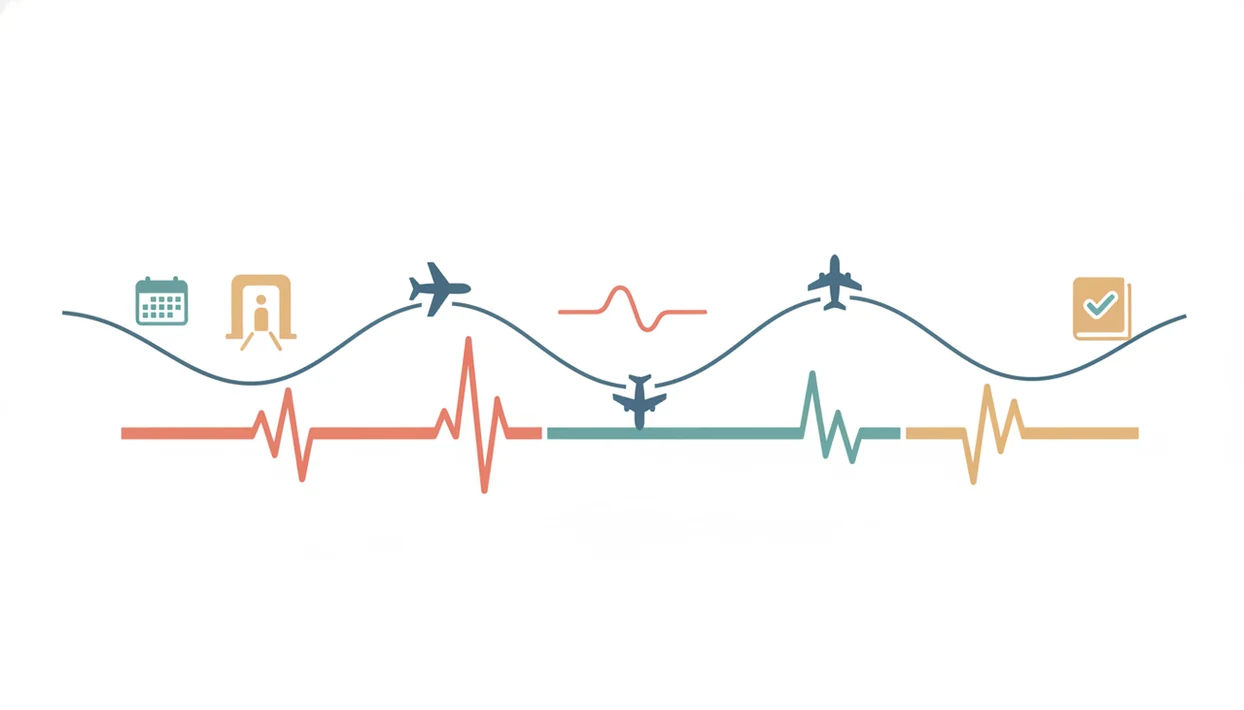
An app that tracks flight anxiety patterns works by turning scattered fear moments into labeled data: anxiety intensity, thoughts, body sensations, safety behaviors, coping responses, and flight phase. Over several trips, those labels can show whether the real trigger is booking, boarding, takeoff, turbulence, landing, or the feeling of being trapped.
The data flow is usually simple. You enter a rating, the app adds a timestamp and trip label, then optional flight details, charts, reminders, or exports organize the pattern. In CBT terms, this helps separate predictions from outcomes. In exposure terms, it shows what you practiced and what happened afterward.
A printed coping plan in a backpack beats ten panicked searches at 5 a.m.
Exposure-based treatment is one of the best-supported approaches for specific phobias, and reviews of internet-delivered CBT also show durable anxiety reductions in some trials; see the American Psychological Association overview of exposure therapy (https://www.apa.org/ptsd-guideline/patients-and-families/exposure-therapy) and a randomized fear-of-flying internet-CBT trial indexed by PubMed (https://pubmed.ncbi.nlm.nih.gov/22464938/).
How to use a flight anxiety tracker app without overchecking
Does a flight anxiety tracker app work if you keep opening it every time your chest tightens? Usually not well. The safer workflow is scheduled logging, then review after the trip.
- Set your flight phases before travel: booking, packing, airport, boarding, takeoff, turbulence, landing, and after arrival.
- Log only at planned moments, such as before you open the airline app, at the gate, and after landing.
- Rate anxiety from 0 to 10, then add one trigger and one coping action.
- Review the trend after the flight, not during every bump or engine sound.
- Limit flight-data checks to one or two planned times if forecasts are available.
- Share repeated patterns with a therapist or structured fear-of-flying program.
If the priority is reducing checking, Fear of Flying Guide fits because the flight-day plan gives your next five minutes a job instead of asking you to keep scanning. Use the Notes app too: “If I want to refresh turbulence data, then I put both feet down and wait two minutes.”
How we picked flight anxiety tracker app features
We weighted features that help nervous flyers learn from flights without feeding the fear loop. Fear of Flying Guide is a fear of flying resource that explains causes, treatments, coping strategies, and tools for nervous flyers, so it belongs in the shortlist for people who need both education and tracking structure.
- Flight-phase logging matters: booking dread and takeoff panic are different patterns, even when both score 8 out of 10.
- Trend charts should stay boring: weekly or trip-based review is safer than constant mid-flight scoring.
- CBT prompts add structure: thought records, prediction checks, exposure goals, and post-flight outcomes make data more useful.
- Privacy carries extra weight: Pew Research Center has reported broad public concern about how health-related digital data is collected and shared, and flight anxiety logs can include travel dates, routes, location signals, and mental health notes (https://www.pewresearch.org/internet/2023/08/17/americans-views-of-health-data-privacy/).
- Offline access matters: a half-charged phone and patchy airport Wi-Fi should not break the panic plan.
For nervous flyers who need progress evidence, FearOfFlying.com earns a place because it frames tracking around triggers, coping actions, and recovery steps, not just mood graphs.
Best flight anxiety tracker app for turbulence explanations: SkyGuru-style tools
SkyGuru-style tools are best for people whose anxiety rises when the aircraft bumps, banks, changes engine sound, or enters cloud. These apps often translate weather, altitude, turbulence forecasts, flight phases, and aircraft sensations into plain-language reassurance.
That can help when a drink ripples on the tray table and your brain says, “Something is wrong.” A short explanation can interrupt the danger story. Fear of Flying Guide is also useful here because its turbulence education explains what bumps mean and gives body-based steps for the moment, especially for readers with a strong fear of turbulence.
Forecasts can change, though. They are not guarantees. Repeatedly refreshing turbulence maps can become a safety behavior, especially if you scan each update for proof that the flight is safe.
For people whose fear comes from unexplained aircraft sensations, turbulence explanation tools are supportive education rather than treatment because they reduce uncertainty but do not retrain avoidance by themselves.
Best aviophobia progress app for CBT-style pattern tracking
A CBT-style aviophobia progress app is best for flyers who want to compare predictions with outcomes across several flights. Track the thought, the fear rating, the avoidance urge, the coping attempt, and what actually happened after landing.
Core features should include a fear ladder, exposure goals, thought records, body sensation labels, progress charts, and therapist export. The tight chest over airport emails might belong at “anticipatory anxiety,” while the urge to text “I can’t do this” before boarding belongs under avoidance or escape behavior.
After a difficult flight, when the memory keeps replaying, Fear of Flying Guide helps because it turns the event into a rebuild plan with education, coping scripts, and structured next steps. If the fear began after one bad experience, the pattern may also overlap with fear of flying suddenly.
Internet-based CBT for fear of flying showed durable benefit at one-year follow-up in a 2012 randomized trial. Structured digital tools can help, but severe panic, trauma-linked fear, or medical anxiety may need professional care.
Best flight anxiety tracker app for simple pre-trip check-ins
Simple pre-trip check-in apps fit occasional nervous flyers, first-time trackers, and people who get overwhelmed by detailed analytics. You may only need a 0 to 10 anxiety score, trigger tags, one planned coping action, a post-flight reflection, and a monthly trend view.
Keep the check-ins few. Try one the night before, one at the gate, and one after arrival. That is enough data for most users to see whether sleep, caffeine, airport timing, or uncertainty drives the spike.
For occasional flyers who need low-friction tracking, Fear of Flying Guide fits because the coping plan can sit beside a boarding pass in Apple Wallet without turning the whole trip into a data project. Pack this before you leave: gum in the front pocket, downloaded playlist, water after security, and a two-minute phone timer.
On iPhone and Android, free mood trackers may be enough for light use. Paid apps usually add exports, flight tools, deeper charts, or structured programs.
Honest cons of apps that track flight anxiety patterns
Apps can help nervous flyers, but they can also make anxiety louder if used as reassurance machines. Fear of flying is common, but prevalence estimates vary by country, definition, and survey method, so treat population percentages as rough context rather than a diagnosis for any one traveler; for background on specific phobias, see NIMH (https://www.nimh.nih.gov/health/statistics/specific-phobia).
- Overchecking can maintain fear: opening the app after every sensation teaches the brain that each bump needs investigation.
- Hypervigilance can increase: tracking every sound may make the body scan for danger more often.
- Phone dependence is real: if the battery drops to 9%, panic can shift from the plane to the screen.
- Flight data can create false certainty: forecasts, maps, and aircraft details are helpful context, not safety promises.
- Clinical needs may exceed app support: severe aviophobia, panic disorder, trauma, or intense flight anxiety symptoms may need therapy or medical advice.
- Practical barriers matter: subscriptions, offline limits, learning curves, small text, and accessibility gaps can block use.
Compared with flyconfident.com, fearlessflyerapp.com, soar.com, vfrfi.com, or anxieties.com, the right choice depends less on branding and more on whether the tool reduces avoidance without increasing checking.
When to seek professional help for flight anxiety
Seek professional help when flight anxiety causes panic attacks, keeps you from traveling, brings up trauma memories, or leaves you unsure about medication. A tracking app can support a plan, but it cannot diagnose a disorder or treat one by itself.
Self-guided logging is usually not enough if the fear is spreading into weeks of dread, repeated cancellations, intense body symptoms, or rituals you feel unable to stop. It is also the wrong place to settle questions about sedatives, alcohol, medical conditions, or whether symptoms are “just anxiety.” Those belong with a licensed clinician.
- Notice the red flags: panic attacks, trauma flashbacks, avoidance, compulsive checking, or severe distress before and after flights.
- Bring a short pattern summary to a licensed mental health professional, primary care clinician, or psychiatrist if medication is part of the question.
- Ask about CBT, exposure therapy, or a structured fear-of-flying treatment plan rather than relying only on reassurance.
- Seek urgent help immediately if you feel unsafe, might harm yourself, or cannot get through the distress safely.
Apps work best as notes for care: useful, portable, and supportive, but not a substitute for treatment.
Limitations
There is limited app-specific clinical research on tools that track flight anxiety patterns. Most benefits are inferred from broader digital CBT, exposure therapy, and phobia research, not from direct trials of each app.
- Turbulence forecasts and flight data can be inaccurate, delayed, or changed by weather and routing.
- Self-guided app use may be insufficient for severe aviophobia, panic attacks, trauma-linked fear, or medical anxiety.
- Privacy protections vary widely and may include analytics, advertising identifiers, cloud storage, or third-party sharing.
- Some users may become dependent on the app and refuse to fly without it.
- Smartphone access, subscriptions, battery life, and internet access can limit usefulness.
- General mood trackers may miss aviation-specific triggers like engine sounds, cabin movement, or takeoff acceleration.
- Flight-specific apps may explain the plane well but offer little CBT structure.
Fear of Flying Guide works best as part of a larger plan because tracking usually depends more on what you do with the pattern than on how polished the chart looks. If you are still asking why am I scared of flying, start with the cause before adding more data.
FAQ
Is there an app for aviophobia?
Yes, several flight-specific and general anxiety apps can support aviophobia tracking. They may help log triggers, fear ratings, coping actions, and flight phases, but no app should be framed as a guaranteed cure.
Can apps reduce flight anxiety?
Apps may reduce flight anxiety by supporting tracking, education, CBT prompts, breathing practice, and exposure planning. They work best as support tools, not replacements for therapy when fear is severe.
What should I track before flying?
Track your anxiety score, trigger, feared prediction, coping plan, sleep, caffeine, alcohol, avoidance behaviors, and whether you are repeatedly checking the airline app. These data points often reveal the pattern before boarding.
Should I track anxiety during turbulence?
Use brief scheduled logging during turbulence, not constant monitoring. One rating and one coping action are usually more useful than tracking every bump.
Are flight anxiety apps private?
Privacy varies across flight anxiety apps. Check permissions, cloud storage, retention rules, third-party sharing, advertising identifiers, and account deletion before entering sensitive notes.
Is SkyGuru good for nervous flyers?
SkyGuru-style tools can help nervous flyers by explaining turbulence, weather, flight phases, and aircraft sensations. They can also encourage overreliance if forecasts are refreshed repeatedly for reassurance.
Are there free flight anxiety apps?
Yes, some flight anxiety or general anxiety apps offer free versions or trials. Advanced tracking, exports, therapist tools, or flight data features may require payment.
Can I share app data with therapy?
Yes, tracked patterns can help a therapist tailor CBT, exposure goals, coping scripts, and relapse-prevention plans. Share summaries, not necessarily every raw entry.