
Why Am I Scared Of Flying When I Know It Is Safe?
You can be scared of flying even when you know it is safe because your brain’s threat system can react faster than your logical reasoning. The answer to “why am I scared of flying” is usually a mix of panic sensations, loss of control, learned associations, stress, and specific flight triggers rather than a lack of safety facts.
> Definition: Fear of flying, also called aerophobia or aviophobia, is a flight-related anxiety response in which the body treats air travel, aircraft sensations, or the idea of flying as a threat even when the person intellectually understands that flying is statistically safe.
- Being scared of flying but knowing it is safe is common because anxiety is driven by the nervous system, not just logic.
- Flight fear psychology often involves specific triggers such as turbulence, takeoff, claustrophobia, heights, loss of control, or fear of panic itself.
- CBT, gradual exposure, and trigger-specific coping skills are better long-term tools than repeatedly checking safety statistics or relying only on medication.
Fear Of Flying Definition: Why Safe Facts Do Not Stop Panic
Fear of flying, also called aerophobia or aviophobia, is a flight-related anxiety response in which the body treats air travel, aircraft sensations, or the idea of flying as a threat even when the person intellectually understands that flying is statistically safe.
That mismatch is the whole problem. Your mind may know the flight is routine, but your body may still produce a racing heart, sweating, nausea, shaking, breathlessness, dry mouth, or a full panic surge. Those symptoms are real, even when the danger estimate is off.
Cleveland Clinic reports that fear of flying affects more than 25 million U.S. adults source. Still, not every nervous flyer has a diagnosable phobia. Some people only feel uneasy during takeoff. Others start checking the airline app the night before a 6:40 a.m. flight and barely sleep.
At A Glance: 6 Reasons You May Be Scared Of Flying
Why am I scared of flying? Usually because one or more fear systems are reacting to the flight, not because you missed a safety statistic.
Common reasons include:
- Threat alarm: your brain predicts danger before you can reason with it.
- Loss of control: you cannot stop, steer, or step outside.
- Body sensations: adrenaline feels like proof something is wrong.
- Confinement: the cabin, seat, and closed door feel trapping.
- Turbulence: movement feels unpredictable, even when it is expected.
- Past stress: a bad flight, burnout, or life pressure lowers your threshold.
Being scared of flying but know safe is not a contradiction. Safety information may reassure the thinking brain, but it does not always retrain the fear system. That is why practical fear of flying causes matter more than generic travel tips.
Five Flight Fear Psychology Facts Nervous Flyers Should Know
- Fear of flying can be a specific phobia. Specific phobias can cause panic, sweating, shaking, nausea, breathlessness, and avoidance. The National Institute of Mental Health estimates that 12.5% of U.S. adults experience specific phobia at some point in life source. - The feared object is not always the plane. The fear may target crashing, turbulence, heights, confinement, loss of control, or panic sensations themselves. - Logic does not automatically switch off alarm. Your boarding pass can be in Apple Wallet, your facts can be solid, and your body can still act threatened. - Stress can raise the volume. Past stressful flights, recent life stress, grief, overload, and burnout can make the same route feel harder. - CBT and exposure have stronger long-term support than medication alone. The most common medically supported way to reduce phobic avoidance is exposure-based practice combined with cognitive and body-sensation skills. For clinical context, the American Psychological Association describes exposure therapy as a treatment that helps people safely face feared situations rather than keep avoiding them source.
For a plain-language overview of the label itself, read what is aviophobia.
How Fear Of Flying Works In The Brain And Body
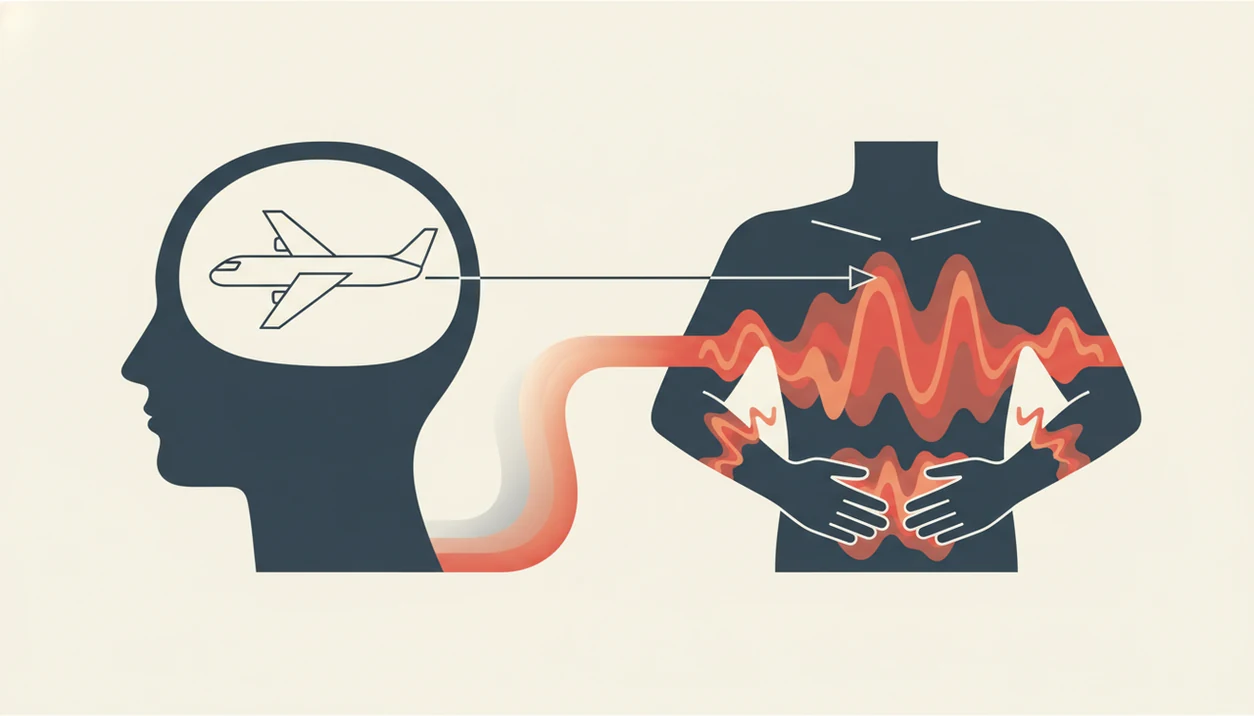
Fear of flying works through threat prediction, learned cues, and fight-or-flight arousal. In plain English, your brain guesses what might happen next, then your body prepares before you have voted on the plan.
The amygdala-style alarm system is often described as fast and protective. It notices cues like takeoff acceleration, engine sounds, seatbelt signs, cabin chimes, turbulence, or a brief drop feeling in the stomach. If those cues get linked with danger, your body may send adrenaline, muscle tension, nausea, and shallow breathing.
Then panic can become the feared event. You may think, “What if I lose control in seat 18A?” rather than “What if the aircraft is unsafe?” That is nervous system conditioning, not weak character.
Intellectual risk assessment asks, “How likely is danger?” The conditioned fear system asks, “Have I felt scared here before?”
Different job. Different speed.
Common Fear Of Flying Triggers: Crash Fear, Turbulence, Claustrophobia, And Control
Two people can both fear flying and need different coping plans. One may picture a crash. Another may fear dizziness, derealization, nausea, a racing heart, or being unable to leave the cabin.
Crash-related flight fear
Crash fear centers on catastrophic images, news stories, or “what if” thoughts. It often spikes before boarding, during takeoff, or when the aircraft banks.
Turbulence and aircraft sensation fear
Turbulence fear is usually sensation-based. A shoulder strap tug during a bump can feel like proof of danger, even when the aircraft is handling normal air movement. If this is your main trigger, a dedicated fear of turbulence plan helps more than broad reassurance.
Claustrophobia and control-related flying fear
Claustrophobia and control fear focus on being trapped, not believed, or unable to exit. Takeoff and landing sensations can intensify this because you must stay seated. The trigger matters because crash fear needs different scripts than panic-sensation fear.
Scared Of Flying But Know Safe: Anxiety Logic Versus Body Sensations
When you are scared of flying but know safe facts, anxiety may be treating discomfort as evidence. The loop is simple: sensation, interpretation, adrenaline, stronger sensation, more fear.
It can start with dry mouth at the gate. Then comes the thought, “Something is wrong.” Adrenaline rises. Your heart beats harder. Now the body feels even more convincing.
Not irrational. Just misread.
Repeated reassurance-seeking can calm you for a few minutes, but it may not retrain the fear. You check the weather app before breakfast, then aircraft type, then turbulence maps, then the same safety article again. The pocket check is real.
How to use this understanding on flight day:
- Name the trigger before you open the airline app.
- Write an if-then script in your Notes app.
- Set a two-minute timer when symptoms spike.
- Give your body one small job, such as feet flat and slow exhale.
- Return to the plan instead of rechecking statistics.
For panic-driven fear, anxiety sensitivity flying is often the missing piece.
How To Use Flight Fear Psychology Before A Flight
Use flight fear psychology by turning your main trigger into a small, repeatable plan before the airport starts making decisions for you. The goal is not to feel fearless; it is to stop changing strategies every time anxiety spikes.
- Identify your lead trigger before you check weather, airline, seat, or turbulence apps. Ask whether the fear is mostly about crashing, turbulence, confinement, panic sensations, or not being in control.
- Write one if-then script while you are still on the ground. For example: “If I feel my heart race during takeoff, then I will label it adrenaline, put both feet flat, and lengthen my exhale.”
- Choose one body cue that is easy to repeat in public. Feet flat, shoulders down, unclenched hands, and a longer exhale work better than a complicated routine you abandon in row 18.
- Limit reassurance checks to one planned window. Check what you need, then stop reopening the same apps for a fresh hit of certainty.
- Use the same plan during boarding, takeoff, turbulence, descent, and landing. Repetition teaches your fear system more than a new safety fact every five minutes.
Stress, Burnout, And Sudden Fear Of Flying
Fear can appear after years of normal flying. Searches like “suddenly scared of flying” or “afraid to fly and I do not know why” often point to a lowered anxiety threshold, not a change in aviation safety.
Recent stress makes threat prediction jumpier. Poor sleep, work overload, caregiving, grief, or health worries can make the cabin feel less tolerable. A difficult flight can also become sticky in memory, even if it was not objectively dangerous.
A 2024 study linked fear of flying not only with flight-related fears, but also with past and recent stressful events and work-related burnout source.
So if you suddenly panic while standing in the jet bridge, it does not mean flying has become more dangerous. It may mean your system arrived already loaded. More detail is covered in fear of flying suddenly.
Fear Of Flying Myths That Keep Nervous Flyers Stuck
Myth: Fear of flying means you are dramatic or irrational. Correction: the fear response is real. The danger estimate may be inaccurate, but the symptoms are not fake.
Myth: Knowing planes are safe should make fear disappear. Correction: safety facts help some people, but they do not always change learned body responses.
Myth: All flight fear is fear of crashing. Correction: many nervous flyers fear turbulence, confinement, heights, takeoff sensations, or panic in public.
Myth: Medication alone cures fear of flying. Correction: medication may reduce symptoms for one flight, but it usually does not teach the brain that flying cues are tolerable.
Myth: Avoiding flights is the safest anxiety plan. Correction: avoidance feels protective short term, but it can make the fear narrower and stronger.
Good fear of flying help explains causes, treatments, coping strategies, and tools for nervous flyers, not just “planes are safe” facts or vague calm-down advice. Tools like Fear of Flying Guide, SOAR, and Fly Confident can be useful when they match the trigger you actually have.
When Fear Of Flying Applies And When It May Be Another Anxiety Pattern
Fear of flying applies when the fear is mainly tied to air travel: booking, airports, boarding, takeoff, turbulence, landing, or thinking about being on a plane. You may function well elsewhere, then unravel when the boarding group is called.
Sometimes the flight is only one stage. Panic disorder, agoraphobia, claustrophobia, trauma memories, health anxiety, or generalized anxiety may also be involved. Labels are not required to start using coping tools, but they can guide the right help.
Clinicians typically recommend assessment when anxiety is severe, spreading, causing major avoidance, or disrupting work, family, or medical travel. If you are tracking symptoms, a simple list of flight anxiety symptoms can make that conversation clearer.
Seek urgent support if fear of flying comes with thoughts of self-harm, feeling unable to stay safe, or panic symptoms that feel medically dangerous. If symptoms are new, severe, or tied to chest pain, fainting, or breathing problems, contact a medical professional rather than assuming it is only anxiety.
Fear of Flying Guide covers this education pathway at FearOfFlying.com, but it should not replace a therapist, doctor, or urgent support when symptoms are intense.
Limitations
This page can explain the pattern, but it cannot diagnose you or guarantee that one coping tool will work on your next flight.
- Information alone may not fix fear of flying because learned fear responses need practice and retraining.
- Medication may reduce symptoms for one flight, but it should be discussed with a licensed clinician and is not usually a complete long-term treatment for phobic avoidance by itself.
- Exposure-based methods can help, but progress may be gradual and uncomfortable.
- Severe panic, trauma history, or long-term avoidance may require a licensed therapist or structured program.
- Not every nervous flyer has the same trigger, so generic advice can miss the real driver.
- Safety statistics can reassure some readers, but they can also become a reassurance loop for others.
- This page is educational. It is not a medical diagnosis, treatment plan, or emergency mental health service.
If you notice repeated checking before every trip, reassurance seeking flight anxiety may be worth naming directly.
FAQ
Why am I scared to fly even though I know planes are safe?
You can know flying is statistically safe while your nervous system still reacts to flight cues as threatening. This is common in fear of flying and specific phobias.
Can fear of flying start suddenly after years of flying?
Yes. Stress, burnout, a difficult flight, panic symptoms, or a major life change can make flying feel threatening after years of normal travel.
Why does turbulence scare me so much?
Turbulence is unpredictable movement, and the body can misread it as danger. The fear often comes from sensation and loss of control, not aircraft safety alone.
Is fear of flying irrational?
The fear response is real, but the danger estimate may be inaccurate. Calling it irrational usually adds shame and does not help retrain the response.
Can panic attacks happen on planes?
Yes. Panic attacks can happen on planes and may include racing heart, breathlessness, sweating, shaking, nausea, or fear of losing control.
Does medication fix fear of flying?
Medication may reduce short-term symptoms for a specific flight. It usually does not retrain the learned fear pattern by itself.
Does CBT help with fear of flying?
CBT can help by targeting fearful thoughts, avoidance, body sensations, and flight-specific triggers. Exposure practice is often part of the treatment plan.
When should I get professional help for fear of flying?
Consider professional help if you avoid important travel, have severe panic, feel trapped by the fear, or notice anxiety spreading beyond flying. A licensed clinician can assess the broader pattern.