
Discover Why Flying Feels Scary For Your Brain
To discover why flying feels scary, match your strongest reactions to a likely fear driver: panic sensations, turbulence, loss of control, confinement, motion, airport stress, or a past event. The fear usually comes from how your brain interprets uncertainty and body sensations, not from the actual risk level of commercial flying.
Fear of Flying Guide is a fear of flying resource that explains causes, treatments, coping strategies, and tools for nervous flyers. This page is educational and is meant to help you name likely fear patterns; it is not a diagnosis or a substitute for care from a licensed mental health or medical professional.
- Flying can feel scary even when you know it is statistically safe because anxiety reacts to perceived threat, uncertainty, and body sensations.
- Your fear pattern matters: turbulence fear, panic fear, control fear, claustrophobia, motion sensitivity, and trauma-linked fear need different coping strategies.
- A flight fear quiz can help you name your likely trigger pattern, but it cannot diagnose a phobia or replace professional care.
7 flight fear quiz patterns
Use this quick flight fear quiz table to find the pattern that sounds most like your last scary flying moment. Pick the row that matches your first spike of fear, not the fear you felt after an hour of worrying.
| Trigger | Common thought | Body reaction | Likely fear driver |
|---|---|---|---|
| Heart racing at takeoff | “I’m about to pass out.” | Tight chest, hot face | Panic sensations |
| Bumpy air | “The plane can’t handle this.” | Knees braced against the seat pocket | Turbulence fear |
| Not being the pilot | “I can’t make it stop.” | Restless scanning | Loss of control |
| Door closing | “I’m trapped.” | Dry mouth, urge to escape | Claustrophobia |
| Banking or descending | “My body feels wrong.” | Nausea, dizziness | Motion sensitivity |
| Security, crowds, timing | “I’m already overloaded.” | Shaky hands, irritability | Airport overwhelm |
| Bad past flight | “It’s happening again.” | Flashback-like fear | Past-event fear |
One row may not cover everything. Start with the loudest one.
Why flying feels scary even when planes are safe
Why flying feels scary when I know it is safe: your anxiety system responds to perceived threat, not to the actual crash probability. That is why a safe flight can still feel unbearable in your body.
Commercial aviation data can reassure the thinking part of your brain. The NTSB reported a 2019 global commercial jet accident rate of 1.13 accidents per 1 million flights, with 240 total accidents across 42.5 million flights source. BTS data also shows fatal events for large U.S. air carriers are extremely rare source.
But numbers do not automatically calm a nervous system. If your chest tightens when an airline email lands three days before departure, your brain is already rehearsing danger. For many nervous flyers, safety facts help most when paired with body skills, exposure practice, and a clear flight-day plan. The broader fear of flying causes picture explains why the fear can start before you reach the airport.
How your brain makes flying feel scary
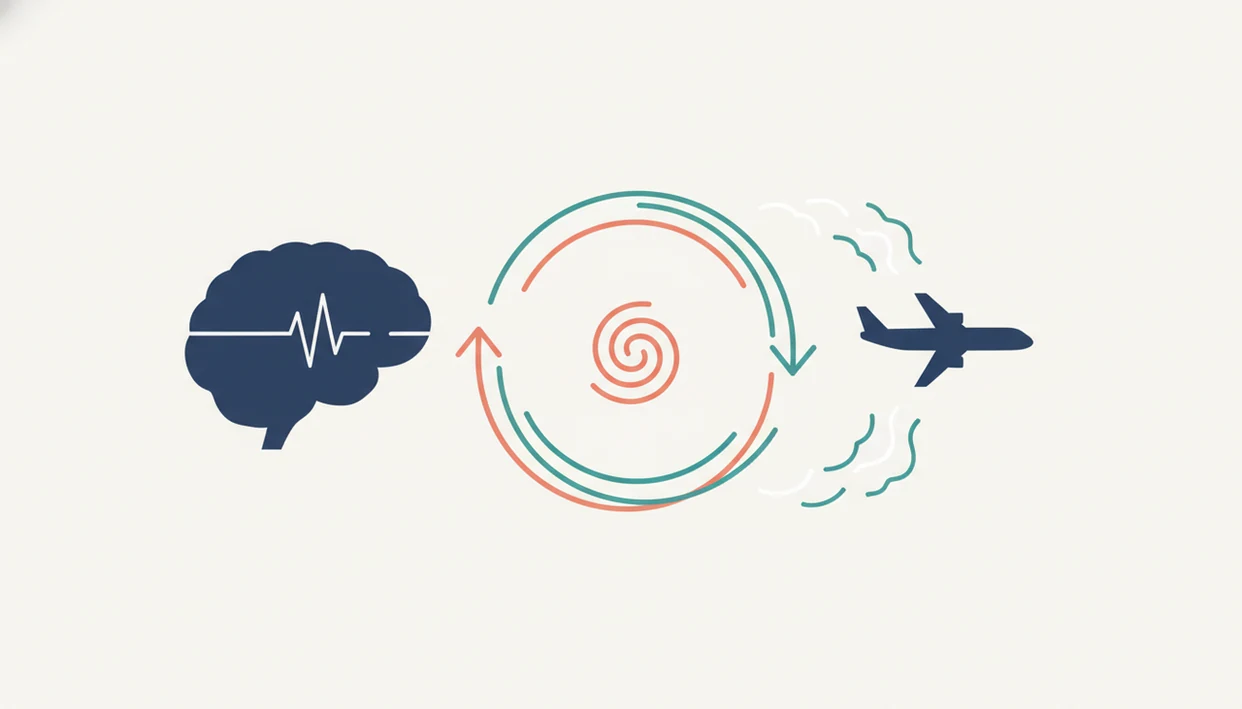
Flying feels scary when the brain’s threat system treats normal flight sensations as danger cues and then predicts catastrophe from them. The loop often includes threat detection, uncertainty, interoception, and catastrophic prediction.
Interoception means noticing internal body signals. On a plane, that might be a skipped breath, stomach drop, ear pressure, or racing heart. Your brain then asks, “What does this mean?” If it answers “danger,” normal events become evidence. Engine noise sounds like strain. Banking feels like falling. Cabin pressure feels like something is wrong. Turbulence becomes a warning instead of rough air.
Rational facts can help, but emotional learning is stubborn. The most common medically supported way to reduce phobic avoidance is gradual exposure combined with cognitive and body-based coping practice. Clinicians typically recommend CBT-style tools and exposure work when flight fear causes major avoidance or distress.
5 facts that explain why flying feels scary
- Fear of flying is common; a large European survey found about 1 in 3 adults report some fear of flying source.
- A smaller group, often estimated around 2–5%, meet criteria for a full specific phobia of flying source.
- Physical anxiety symptoms are real body events, but they are not proof that the aircraft is in danger.
- Fear profiles matter because turbulence fear, panic fear, control fear, and claustrophobia respond to different tools.
- CBT with exposure is a well-supported treatment approach for specific phobias, including fear of flying, but improvement rates vary by severity, co-occurring conditions, and treatment format source.
Pack this before you leave: a short Notes app coping card with your top fear driver written in plain words. “My body is panicking” leads to a different next step than “I need turbulence education.”
Flight fear quiz steps for finding your pattern
Use a flight fear quiz as a map, not a diagnosis. Your goal is to spot repeatable patterns before you open the airline app again at midnight.
- Rate your triggers from 0 to 10: booking, packing, security, boarding, takeoff, turbulence, cruise, descent, and landing.
- Track your body symptoms such as chest tightness, nausea, sweating, dizziness, or breath-holding.
- Identify your main thought in one sentence, such as “I’ll panic,” “We’ll fall,” or “I can’t get out.”
- Compare the pattern with panic, turbulence, control, confinement, motion, airport overwhelm, or past-event fear.
- Choose one coping experiment for your next five minutes, such as paced breathing, a pilot explanation, or an if-then script.
A quiz can guide self-understanding, but it cannot diagnose panic disorder, PTSD, specific phobia, or a medical condition. Tools like Fear of Flying Guide can support pattern-finding, not replace a clinician.
Flight fear tracking method
Track flight fear at seven checkpoints: before-flight, airport, takeoff, cruise, turbulence, descent, landing, and after-flight. Repeated patterns are more useful than one isolated scary moment.
Use a simple note with five columns: trigger, thought, body sensation, avoidance urge, and what helped. At the airport, your entry might read: “Boarding group called. Thought: I can’t do this. Body: dry mouth. Urge: leave line. Helped: water bottle, two-minute timer, texted my plan.”
Make the plan boring on purpose. You are not trying to write a diary entry. You are collecting clues. If takeoff fear always arrives with heart symptoms, read more about flight anxiety symptoms. If fear appeared out of nowhere after years of easy flying, the pattern may fit fear of flying suddenly.
3 nervous flyer stories that reveal fear patterns
These are examples, not research data. Use them to recognize a pattern, then adjust the next step to your own flight.
Maya: panic sensations at takeoff
Maya feels the engines spool and thinks, “My heart can’t handle this.” Her likely driver is panic sensations, especially anxiety sensitivity. Her next step is a body script: “This is adrenaline, not danger,” plus slow exhale breathing.
Chris: turbulence and loss of control
Chris watches the wing flex outside the window and grips the armrest. His likely driver is turbulence plus control fear. His next step is learning what turbulence is, then practicing one small job for his body during bumps. The fear of turbulence pattern often needs education and repetition.
Leah: confinement and airport overwhelm
Leah feels trapped before boarding because security, crowds, and timing already drained her. Her likely driver is confinement mixed with overload. Her next step is an airport plan with fewer decisions and a seat routine.
Common flight fear patterns behind scary flights
Common flight fear patterns include turbulence fear, panic fear, loss-of-control fear, claustrophobia, heights, health worries, motion sensitivity, social embarrassment, and past-event fear. Each pattern points toward a different coping direction.
Turbulence fear often needs aviation education and body bracing alternatives. Panic fear needs work with sensations, breathing, and catastrophic thoughts. Control fear benefits from if-then scripts and predictable routines. Claustrophobia may need gradual exposure to enclosed settings. Heights fear can overlap with visual triggers, especially window seats. Health worries need careful medical guidance when symptoms are unclear. Motion sensitivity may improve with seat choice, medication advice, or vestibular support.
Airport stress matters too. A half-charged phone, tangled headphones, and a delayed gate screen can prime the nervous system before takeoff. A good nervous flyer guide should give causes, treatment options, coping strategies, and tools, not vague reassurance or airline-style cheerleading. FearOfFlying.com covers these pieces as a connected pathway.
Flight fear quiz blind spots
A flight fear quiz can name likely triggers, but it cannot diagnose panic disorder, PTSD, specific phobia, medical problems, or substance-related issues. It also cannot tell whether your dizziness is anxiety, dehydration, medication side effects, or something that needs medical review.
Co-occurring anxiety can change the plan. Someone with panic disorder may need interoceptive exposure. Someone with trauma history may need trauma-informed therapy before flight exposure. Someone using alcohol or sedatives to board may need medical guidance, not another breathing tip.
Get professional support if you avoid important trips, have intense panic, feel haunted by a frightening flight, or worry about harming yourself. Also seek help for complex medical concerns, pregnancy-related questions, or psychiatric medication decisions. If you are trying to understand what is aviophobia, diagnosis belongs with a qualified professional, not an online score.
Limitations
Self-assessment is useful, but it has clear limits. Use it as a starting point, not as a final answer.
- A self-assessment can highlight likely triggers, but it cannot diagnose an anxiety disorder.
- Safety statistics alone often do not reduce entrenched flight phobia.
- Not everyone responds to CBT or exposure therapy at the same speed.
- Some people need licensed mental health support, especially with trauma, severe panic, or avoidance.
- Medical or psychiatric conditions may change which coping strategies are appropriate.
- Online tools cannot monitor real-time distress during a flight.
- Medication, alcohol use, panic symptoms, and medical symptoms should be discussed with a qualified professional when risk is unclear.
If your fear is shaping work, family, or health decisions, do not wait for the next flight to force the issue. Build care before the boarding pass hits Apple Wallet.
FAQ
Why am I scared to fly?
You may be scared to fly because of panic sensations, uncertainty, loss of control, confinement, turbulence, motion sensitivity, or a past experience. The main trigger often shows up before the strongest fear peak.
Is flying scary for everyone?
Flying is not scary for everyone, but fear of flying is common and varies widely. Some people feel mild tension, while others avoid flights completely.
Why does takeoff feel scary?
Takeoff can feel scary because acceleration, engine noise, angle changes, and body arousal happen at the same time. Anxiety may misread those normal sensations as danger.
Does turbulence mean danger?
Turbulence is expected during many flights and is usually uncomfortable rather than dangerous. Pilots and aircraft are built to handle routine turbulent air.
Can panic happen on planes?
Panic can happen on planes and may cause racing heart, shortness of breath, dizziness, sweating, or fear of losing control. These symptoms can feel dangerous even when they are anxiety responses.
Can a flight fear quiz help?
A flight fear quiz can help identify likely trigger patterns, such as panic, turbulence, control, confinement, or past-event fear. It cannot diagnose an anxiety disorder.
When should I get therapy?
Consider therapy if flying fear causes severe avoidance, panic attacks, trauma reactions, or major life disruption. Fear of Flying Guide can help with education, but therapy is better for complex or severe symptoms.