
Check Flight Anxiety Triggers Before Your Next Trip
To check flight anxiety triggers, break your fear into specific moments, sensations, thoughts, and situations before you fly. A short trigger map helps you choose the right coping tool for turbulence, claustrophobia, panic symptoms, takeoff, airport stress, or fear of losing control.
Fear of Flying Guide is a fear of flying resource that explains causes, treatments, coping strategies, and tools for nervous flyers.
- A flight anxiety checklist works best when it names exact triggers instead of treating fear of flying as one vague problem.
- Common fear of flying triggers include turbulence, takeoff, confinement, loss of control, panic sensations, scary news, and stressful life events.
- Trigger-checking is useful, but severe avoidance, panic attacks, or phobia-level fear may need CBT, exposure therapy, or clinician-guided treatment.
Flight Anxiety Trigger Checklist At a Glance
A flight anxiety trigger checklist sorts fear into six buckets: body sensations, cabin environment, flight phases, thoughts, memories, and life stress. The goal is not to prove your fear is “irrational.” The goal is to match the fear to the right tool before your next five minutes get hijacked.
Use these categories:
- Body sensations: racing heart, dry mouth, sweating, dizziness.
- Cabin environment: closed doors, crowded rows, engine noise, limited exits.
- Flight phases: booking, boarding, taxi, takeoff, cruise, turbulence, landing.
- Thoughts: “I’m trapped,” “the plane will drop,” “I’ll panic.”
- Memories: a rough flight, a news story, a previous panic attack.
- Life stress: burnout, grief, conflict, poor sleep.
A U.S. survey reported that about 40% of adults experience some fear of flying and about 12.6% report phobia-level fear (https://www.frontiersin.org/articles/10.3389/fpsyg.2022.988128/full). So no, you’re not unusual. But triggers vary widely, which is why generic “calm down” advice often misses the real fear.
Flight Anxiety Triggers in the Brain and Body
How flight anxiety triggers work: a cue gets interpreted as danger, the body alarm turns on, you use a safety behavior to feel safer, and the brain learns to repeat the pattern next time. In plain English: something happens, your brain labels it dangerous, your body surges, you try to escape or control it, and the pattern gets stronger next time.
Turbulence, cabin sounds, the door closing, and takeoff can all become danger cues. The overhead bin latch softly rattling may be read as “something is wrong,” even when the aircraft is operating normally. Claustrophobia and perceived lack of control can feel more threatening than the actual flight risk.
A large accident-data analysis estimated the fatal accident rate for commercial passenger flights in high-income countries at about 0.06 per million flights (https://doi.org/10.1016/j.ress.2019.106449). That statistic matters, but it does not automatically calm a nervous system already in alarm mode. Objective safety and perceived threat are different problems.
Clinicians typically recommend matching anxiety tools to the trigger pattern, especially when fear causes avoidance or panic.
5 Steps to Use a Flight Anxiety Checklist Before Flying
Use a flight anxiety checklist before travel day, not when you’re already in peak panic at the gate. The night before a 6:40 a.m. flight, before you open the airline app for the tenth refresh, put the plan in your Notes app.
- List flight phases from booking through landing, including airport arrival, security, boarding, takeoff, cruise, descent, and baggage claim.
- Rate each trigger from 0 to 10, so you know whether taxi or turbulence needs more preparation.
- Name the thought attached to each trigger, such as “I can’t leave” or “my heart means danger.”
- Pair one coping tool with each high trigger, such as breathing, grounding, aviation education, or an if-then script.
- Rehearse the plan once calmly, then stop checking, because the checklist is not a danger scanner.
Make the plan boring on purpose. If tomorrow’s flight is close, a simple pre-flight anxiety routine can keep the checklist from turning into endless preparation.
Fear of Flying Triggers by Flight Phase
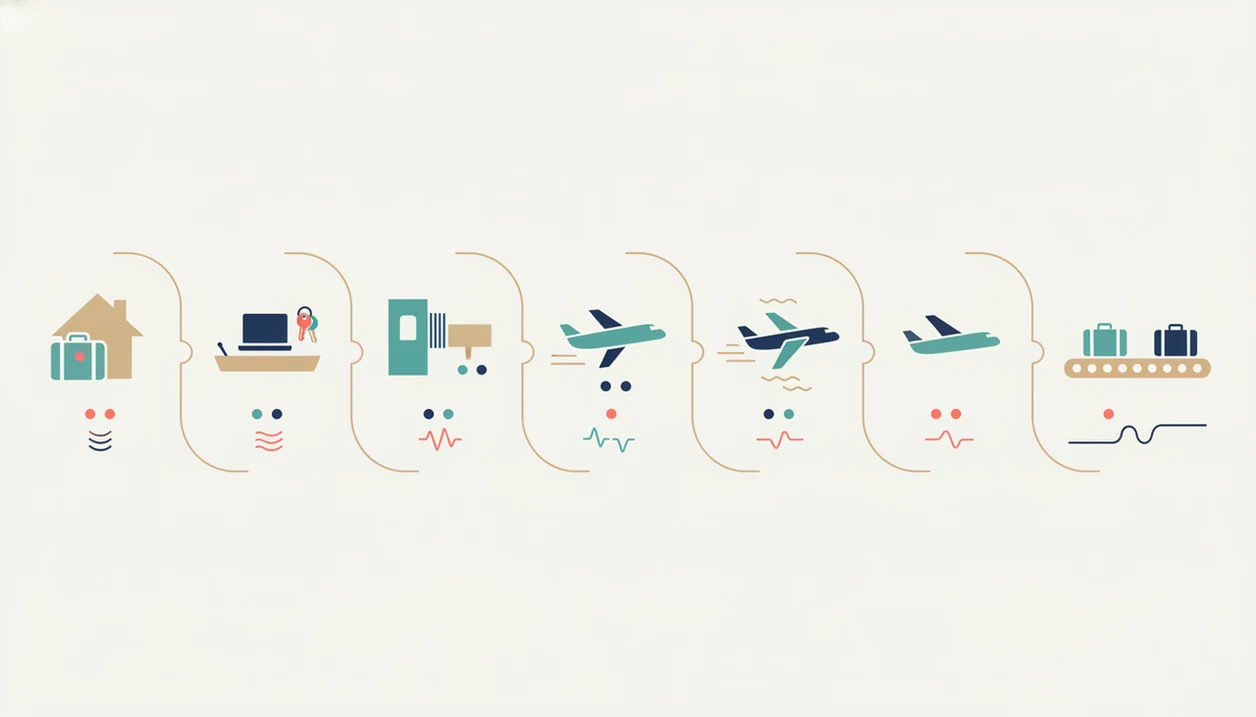
Fear of flying triggers change by phase, so your coping tools should change too. Anticipatory anxiety often starts before the airport; in-flight panic usually spikes when escape feels impossible or body sensations intensify.
| Flight phase | Common trigger | Useful coping tool |
|---|---|---|
| Booking | Committing to the trip | Write an if-then script |
| Packing | “What if I can’t cope?” | Pack coping card, gum, headphones |
| Airport arrival | Crowds and time pressure | Slow walk, water, simple schedule |
| Security | Feeling watched or rushed | One small job for your body |
| Boarding | Point of no return | Jet bridge script |
| Door closing | Trapped feeling | Seat plan and breathing |
| Taxi | Waiting with no exit | Two-minute phone timer |
| Takeoff | Engine power and angle | Sensation reframing |
| Cruise | Monitoring sounds | Downloaded playlist |
| Turbulence | Motion and uncertainty | Grounding plus safety education |
| Descent | Ears, turns, bumps | Gum and paced breathing |
| Landing | Final noises and braking | Name normal sensations |
The most useful flight anxiety checklist separates “I dread the trip” from “I panic when the door closes,” because those fears need different tools.
Five Flight Anxiety Triggers Most People Miss
Some fear of flying triggers are not really about the aircraft. The plane becomes the visible trigger when your body is already overloaded.
- Burnout can sensitize the alarm system. A 2023 study linked work-related burnout with fear of flying, so include workload in your checklist.
- Recent loss or stress can raise baseline anxiety. A breakup, illness, or family crisis may make normal flight sensations feel harder to tolerate.
- Scary aviation content can prime the brain. Crash videos and dramatic headlines can become mental images during taxi or takeoff.
- Fear of panic can become the main trigger. You may fear the racing heart more than the plane itself; use panic attack on plane planning if this fits.
- Control rituals can backfire. Rechecking weather, seat maps, or aircraft type may give short relief, then teach your brain that constant checking is required.
Include non-aviation stressors. They count.
Three Trigger Profiles for Nervous Flyers
These trigger profiles are examples, not diagnoses. They help you spot which fear pattern deserves the most attention before you fly.
Turbulence-triggered anxiety
This flyer does fairly well until the ride gets bumpy. A lavatory line halted mid-cabin may send the brain straight to “danger,” even though turbulence is usually a comfort issue rather than a control issue. Education, grounding, and ride-sensation reframing matter here.
Claustrophobia-triggered anxiety
This flyer fears being trapped after boarding. The safety card held in damp fingers becomes the moment the body says, “I need out.” Seat choice, gradual exposure, breathing skills, and a short boarding script can help.
Panic-sensation anxiety
This flyer fears the body alarm itself: heart racing, heat, dizziness, unreality. Panic-specific CBT tools usually fit better than aviation facts alone, because the feared object is the sensation.
For panic-focused flyers, naming body sensations is often more useful than debating flight safety because the fear target is internal.
Trigger-Matched Coping Tools for Flight Anxiety
Trigger-matched coping tools work better than one-size-fits-all tips because they answer the fear you actually have. A useful fear of flying resource should give causes, treatments, coping strategies, and tools for nervous flyers, not vague reassurance or airline-style cheerleading.
| Trigger pattern | What it feels like | Better-matched tool |
|---|---|---|
| Turbulence | “The plane is falling” | Aviation education, feet-on-floor grounding |
| Confinement | “I’m trapped” | Seat planning, gradual exposure, paced breathing |
| Catastrophic thoughts | “This will end badly” | Cognitive reframing and written evidence |
| Panic sensations | “My body is unsafe” | Panic-focused CBT skills |
| Severe avoidance | “I can’t board” | CBT, exposure therapy, clinician support |
A randomized controlled trial of cognitive-behavioral group treatment for fear of flying found reduced flight-anxiety scores, with benefits maintained at follow-up (https://doi.org/10.1016/S0005-7967(01)00052-2). Tools like Fear of Flying Guide, SOAR, and airline fear-of-flying courses can support rehearsal, but severe avoidance often needs human care too. The broader fear of flying help path is usually education plus practice, not one trick.
CBT usually works best when it targets the specific trigger loop, while general calming exercises fit milder, situation-based anxiety.
Limitations
A checklist can clarify fear of flying triggers, but it cannot diagnose an anxiety disorder or replace therapy. Use it as a planning tool, not as a test you must pass before boarding.
- A flight anxiety checklist is not a diagnosis.
- Some people need CBT, exposure therapy, medication, or clinician support.
- Trigger tracking can become hypervigilance if you monitor every heartbeat, sound, or bump.
- Some triggers, including turbulence and sudden cabin noises, cannot be removed from flying.
- Alcohol or unsupervised sedatives can impair safety, worsen anxiety, and avoid the real fear pattern.
- Online crash content and sensational aviation stories can reinforce intrusive images.
- If you rely on a partner to reassure you every few minutes, reassurance may become another ritual.
Hard truth: some flights will still feel uncomfortable.
If fear is worsening, blocking important travel, or causing panic attacks, talk with a qualified clinician. FearOfFlying.com can be a starting point for education, but it should sit alongside professional support when symptoms are severe.
FAQ
What triggers flight anxiety?
Common flight anxiety triggers include turbulence, takeoff, confinement, panic symptoms, lack of control, past bad flights, and scary aviation stories. Stress, burnout, and poor sleep can also make these triggers feel stronger.
Why does turbulence scare me?
Turbulence can feel dangerous because it combines motion, uncertainty, noise, and lack of control. It is usually a routine part of flying, but the body may still read the movement as threat.
Can flight anxiety cause panic attacks?
Yes, flight cues can trigger panic symptoms such as racing heart, dizziness, sweating, and shortness of breath. Those symptoms can then become a trigger themselves if you start fearing the sensations.
Is claustrophobia common on planes?
Yes, cabin confinement, closed doors, crowded seating, and limited exit options are common fear of flying triggers. Seat planning and gradual exposure may help, especially when practiced before the trip.
Should I track anxiety symptoms before a flight?
Brief symptom tracking can help if it leads to a coping plan. It can backfire if it becomes constant body monitoring or repeated checking for danger.
Do flight anxiety apps help nervous flyers?
Flight anxiety apps can help with checklists, breathing practice, aviation education, and rehearsal. Tools such as Fear of Flying Guide are not substitutes for therapy when symptoms are severe or worsening.
When should I get professional help for flight anxiety?
Get professional help if you avoid important trips, have panic attacks, feel severe distress, or need alcohol or sedatives to fly. Severe or worsening symptoms should be discussed with a qualified clinician.