
Flight Anxiety Symptoms, Panic Feelings, and Medical Red Flags
Flight anxiety symptoms commonly include racing heart, sweating, shaking, nausea, dizziness, shortness of breath, tight chest, and thoughts of losing control before or during a flight. These feelings can be panic, but new crushing chest pain, fainting, stroke signs, or severe breathing trouble should be treated as urgent medical red flags.
> Definition: Flight anxiety symptoms are the physical, mental, and behavioral signs that the body’s threat system activates around flying, even when the flight itself is not objectively dangerous.
- Common fear of flying symptoms include palpitations, sweating, trembling, nausea, dizziness, chest tightness, clouded thinking, and a strong urge to cancel or escape.
- Panic symptoms flying can feel medically frightening, but in otherwise healthy people they are often driven by adrenaline, muscle tension, and overbreathing.
- Seek urgent medical help for new crushing chest pain, fainting, severe shortness of breath at rest, stroke signs, or symptoms in someone with known heart or lung disease.
Flight Anxiety Symptoms at a Glance
- Physical symptoms: Racing heart, sweating, shaking, nausea, dizziness, shortness of breath, chest tightness, hot flashes, chills, and dry mouth can all happen with flight anxiety.
- Mental symptoms: Doom thoughts, derealization, tunnel focus, “I can’t do this,” and trouble processing simple instructions often appear when the threat system is high.
- Behavioral symptoms: Avoiding booking, delaying packing, checking the airline app repeatedly, seeking reassurance, or wanting to leave the gate are common fear patterns.
- Timing: Symptoms may start before booking, while packing, at airport arrival, during boarding, at takeoff, in turbulence, on descent, or after landing.
- Safety meaning: Intense symptoms do not automatically mean the aircraft is unsafe; they often mean your body has misread flying as immediate danger.
The calendar alert three days before departure can be enough. One small buzz, and your stomach drops.
Fear of Flying Symptoms in the Body
Flight anxiety symptoms happen when the fight-or-flight response releases adrenaline, tightens muscles, speeds breathing, and pushes attention toward possible danger. In plain language, your body prepares for escape when escape is not useful.
How flight anxiety works: the brain pairs flying cues with threat, then scans enclosed cabins, engine sounds, heights, turbulence, and uncertainty for proof that something is wrong. Hyperventilation can add tingling, dizziness, chest tightness, and a feeling of not getting enough air. The overhead bin latch softly rattling may become the whole story, even when everyone else is reading.
Panic symptoms can peak quickly and fade while you remain seated. That matters. Specific phobia is one possible explanation for intense flying fear, but not every nervous flyer has a diagnosable disorder. If you want the broader clinical meaning, what is aviophobia explains the label without turning every rough flight into a diagnosis.
Panic Symptoms Flying Versus Medical Red Flags
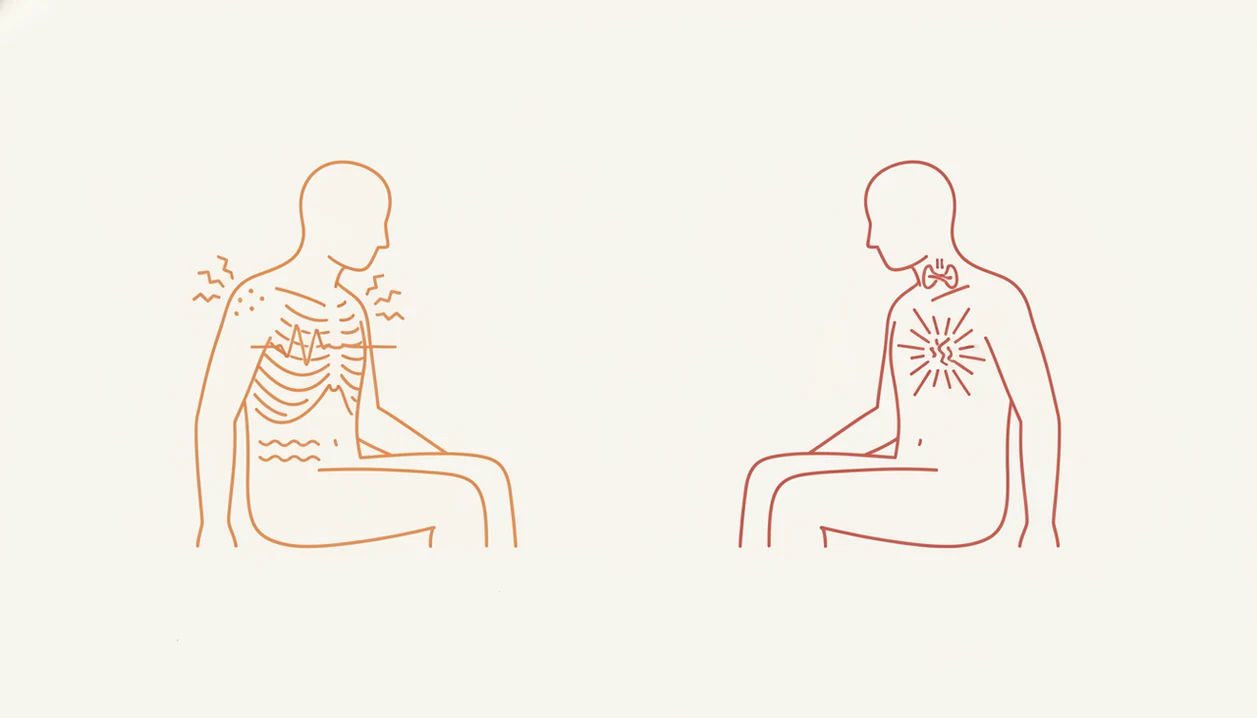
Panic symptoms flying can mimic medical danger, but red flags need urgent assessment. If symptoms are new, severe, one-sided, or not changing with calming and time, treat them seriously.
| More typical panic symptoms flying | Urgent medical red flags |
|---|---|
| Racing heart that rises with fear | New crushing chest pain or pressure |
| Tingling in fingers, lips, or face | Fainting or loss of consciousness |
| Trembling, sweating, shaky legs | Severe shortness of breath at rest |
| Tight chest that changes with breathing or posture | One-sided weakness or numbness |
| Breathlessness during panic surges | Facial droop or trouble speaking |
| Fear of dying, losing control, or going “crazy” | Blue lips or severe allergic swelling |
| Tunnel vision or feeling unreal | Wheezing, hives, throat tightness, or collapse |
Alert cabin crew if symptoms feel unmanageable in the air. After landing, seek emergency care or call local emergency services for red flags. Don’t debate it in the Notes app.
Emergency guidance treats chest pain, fainting, severe breathing trouble, one-sided weakness, facial droop, or trouble speaking as symptoms that need urgent assessment rather than self-diagnosis (CDC stroke signs: https://www.cdc.gov/stroke/signs-symptoms/index.html; NHS chest pain guidance: https://www.nhs.uk/conditions/chest-pain/).
When to Seek Medical or Professional Help
Get medical or professional help when symptoms could be more than panic, or when fear is starting to control your life. Panic can feel awful and still pass; crushing chest pain, fainting, stroke signs, severe breathlessness, blue lips, throat swelling, collapse, or one-sided weakness should not be self-managed.
Use a simple plan before you fly:
- Alert cabin crew, airport staff, or local emergency services if symptoms are severe, sudden, unusual for you, or linked to allergic swelling, chest pressure, fainting, or trouble speaking.
- Contact a doctor before booking or flying if you are pregnant, have heart disease, lung disease, recent surgery, clotting risk, fainting episodes, complex medications, or symptoms you have never had checked.
- Ask about fitness to fly after operations, serious illness, breathing problems, pregnancy complications, or any condition where cabin pressure, immobility, or low oxygen could matter.
- Seek therapy if flying fear causes repeated panic attacks, avoidance, trauma memories, intrusive crash images, compulsive checking, or cancelled work, family, or medical trips.
- Treat panic skills as support, not diagnosis. Slow exhales and grounding are useful; they are not a substitute for urgent care when red flags appear.
Fear of Flying Symptoms Before the Trip
“Why do I feel sick days before my flight?” Anticipatory anxiety can start before booking, then spike during packing, online check-in, the drive to the airport, or the wait at the gate.
Common pre-trip symptoms include compulsive weather checking, crash-news searching, reassurance seeking, insomnia, irritability, stomach upset, and a hard urge to cancel. I’ve seen people refresh the airline app the night before a 6:40 a.m. flight until the boarding pass in Apple Wallet feels like a threat.
Avoidance usually lowers fear for a few hours, but it can keep the phobia strong over time. Mild fear of flying is common, while clinical fear is less common; a 2021 German population study reported about 24% with some fear of flying and 5.6% meeting criteria for clinical fear (Frontiers in Psychology: https://www.frontiersin.org/articles/10.3389/fpsyg.2021.653850/full). If the fear appeared out of nowhere, fear of flying suddenly may fit better.
Fear of Flying Symptoms During the Flight
In-flight symptoms often cluster around takeoff, turbulence, cruising, landing, being seated away from exits, or feeling trapped. Your body may act as if the cabin door closing with a thud removed every option, even though you still have a plan.
You might notice palpitations, sweating, shaking, nausea, dizziness, hot flashes, chills, dry mouth, bathroom urgency, tight muscles, and difficulty concentrating. Turbulence can trigger a body alarm because the motion feels uncontrolled. It is usually a normal flight condition, but your nervous system may treat the drop, bump, or bank as evidence.
Use your next five minutes. Slow your exhale, name five things you can see, sip water, loosen your shoulders, and tell a flight attendant if symptoms feel unmanageable. For more on the motion itself, the fear of turbulence guide separates aircraft movement from panic meaning.
Flight Anxiety Symptom Myths
- Myth 1: Heart pounding on a plane always means a heart attack. Panic can cause a hard, fast heartbeat, chest tightness, and fear of dying. New, crushing, or severe chest pain still needs medical evaluation.
- Myth 2: Real fear of flying only starts after takeoff. Many people feel worse before the trip, especially while packing, checking in, or standing in the boarding line.
- Myth 3: Avoiding all flights is the safest long-term plan. Avoidance can shrink your life and teach your brain that flying was only survived because you escaped it.
- Myth 4: Medication is the only reliable option. CBT, exposure-based practice, breathing, grounding, and education can reduce symptoms for many flyers.
The most common medically supported way to reduce phobic fear is gradual exposure combined with cognitive and body-based coping skills.
A good fear of flying resource should explain causes, treatments, coping strategies, and tools for nervous flyers, not promise instant calm or dismiss medical red flags.
Flight Anxiety Symptoms Linked to Other Conditions
Flight anxiety symptoms can overlap with motion sickness, vertigo, migraine, dehydration, low blood sugar, medication effects, trauma history, claustrophobia, and panic disorder. That overlap makes self-diagnosis unreliable, especially when nausea, dizziness, chest tightness, or shortness of breath are involved.
Pack this before you leave: a medication list, a snack, water after security, and any clinician instructions you’ve already been given. People with heart disease, lung disease, pregnancy, fainting history, recent surgery, clotting risk, or complex medication use should get medical advice before flying.
Fear of Flying Guide focuses on flying-related anxiety rather than diagnosing medical illness. For patterns driven by fear of body sensations, anxiety sensitivity flying is often a useful next concept. Tools can help you sort patterns, but they can’t replace a clinician who knows your health history.
Evidence-Based Help for Flight Anxiety Symptoms
- CBT helps target the fear loop. It works on catastrophic thoughts, avoidance habits, safety behaviors, and the meaning you attach to sensations. - Exposure-based therapy builds tolerance. Gradual practice with airports, flight sounds, videos, seat maps, or short flights can retrain the alarm system. Clinical guidance commonly supports CBT and exposure-based approaches for specific phobias, including situational phobias such as flying-related fear (NICE CKS: https://cks.nice.org.uk/topics/phobias/; NHS: https://www.nhs.uk/mental-health/conditions/phobias/treatment/). - Education reduces misinterpretation. Learning why ears pop, engines change sound, and turbulence happens can lower the “something is wrong” story. - Breathing and grounding give the body a job. A two-minute phone timer, slower exhales, and a simple object-focus exercise are practical in a tight seat. - Medication can help some people short term. It should be clinician-guided, never mixed with alcohol, and not treated as the whole plan.
Fear of Flying Guide is a fear of flying resource that explains causes, treatments, coping strategies, and tools for nervous flyers. Tools like FearOfFlying.com, SOAR, and FlyConfident can support practice, but severe phobia or repeated panic attacks usually need more than a tip list.
Medical Sources Used for This Guide
This guide uses government and clinical sources to keep red-flag advice separate from ordinary panic sensations. Those sources inform education only; they cannot diagnose your symptoms, clear you to fly, or replace care from a clinician who knows your history.
For urgent symptom guidance, the page draws on public health and clinical references such as the CDC for stroke warning signs and NHS guidance for chest pain and phobia treatment. For flying fear treatment, it reflects mainstream clinical guidance that supports CBT, exposure-based therapy, and gradual practice for specific phobias and situational anxiety. The practical coping sections translate that evidence into plain language: what the alarm system is doing, what avoidance teaches the brain, and when symptoms need a medical line instead of another breathing exercise.
When reading the sources behind this page:
- Use red-flag lists as a reason to seek urgent help, not as a home diagnosis tool.
- Treat CBT and exposure evidence as treatment direction, not a promise of instant calm.
- Ask a clinician about personal risks such as heart, lung, pregnancy, surgery, clotting, or medication issues.
- Note that this page was last medically and editorially checked in January 2026.
Limitations
Online symptom guides can help you sort patterns, but they cannot safely diagnose anxiety or rule out emergencies. This guide is educational, not a diagnosis, treatment plan, or clearance to fly. If your symptoms are new, severe, medically unusual for you, or linked to a known health condition, use a clinician or emergency service rather than an online symptom list.
- Online articles cannot reliably distinguish anxiety from heart, lung, neurologic, allergic, or other medical emergencies.
- Self-help tools may be insufficient for severe phobia, repeated panic attacks, trauma symptoms, or avoidance that disrupts work, family, or health care.
- Sedatives can cause drowsiness, confusion, falls, disinhibition, memory problems, or interactions with alcohol and other medications.
- People with heart disease, lung disease, pregnancy, recent surgery, clotting risk, fainting, or complex medication use need medical guidance before flying.
- Good therapy can reduce symptoms, but it may not eliminate all anxiety during turbulence, long flights, delays, or crowded cabins.
- Statistics about fear of flying vary by country, definition, and study method.
- Cabin crew can support you during distress, but they are not a substitute for emergency medical evaluation when red flags appear.
Make the plan boring on purpose. But make the medical line clear.
FAQ
What are flight anxiety symptoms?
Flight anxiety symptoms are physical, mental, and behavioral signs of fear around flying, including racing heart, sweating, shaking, nausea, dizziness, tight chest, doom thoughts, and urges to avoid the flight.
Can flight anxiety cause chest pain?
Flight anxiety can cause chest tightness or pain through muscle tension, adrenaline, and overbreathing. New, severe, crushing, or unusual chest pain needs urgent medical help.
Why do I panic before flying?
Pre-flight panic often comes from anticipatory anxiety, perceived loss of control, uncertainty, past flight memories, or fear of body sensations. It can start days or weeks before travel.
Can turbulence trigger panic attacks?
Yes, turbulence can activate the threat system because the movement feels sudden and uncontrolled. Slow breathing, grounding, and reminding yourself that turbulence is usually normal can help.
Can anxiety cause shortness of breath during a flight?
Anxiety can cause shortness of breath through rapid breathing and chest muscle tension. Severe, new, or resting breathlessness should be assessed urgently.
When is flight anxiety dangerous?
Flight anxiety may be dangerous when symptoms include fainting, stroke signs, blue lips, severe allergic symptoms, crushing chest pain, or severe shortness of breath at rest.
Can flight anxiety cause nausea?
Yes, anxiety can cause nausea through stress hormones, stomach tension, and changes in breathing. Motion sickness, dehydration, and low blood sugar can add to it.
Can flight anxiety symptoms continue after landing?
Yes, symptoms can continue after landing as shakiness, fatigue, headache, stomach upset, or emotional exhaustion. Persistent, worsening, or unusual symptoms need medical advice.
What helps panic symptoms while flying?
Breathing with longer exhales, grounding, hydration, crew communication, CBT skills, and exposure-based practice can help panic symptoms while flying. Medication may help some people, but it should be clinician-guided.