
Reassurance Seeking Flight Anxiety and the Checking Loop
Reassurance seeking flight anxiety is the pattern of repeatedly checking forecasts, safety statistics, forums, apps, or other people for certainty before or during a flight. The short-term relief feels helpful, but the repeated checking teaches your brain that flying uncertainty is dangerous unless you keep checking.
> Definition: Reassurance seeking flight anxiety is repetitive, anxiety-driven checking or questioning about flight safety that temporarily reduces fear but strengthens the urge to check again.
TL;DR
- Useful flight education answers a question once; compulsive reassurance checking repeats the same question to feel certain.
- Turbulence forecast checking, weather app refreshing, safety-stat searches, and repeated questions to loved ones or crew can become part of the same anxiety loop.
- The goal is not to feel zero anxiety before flying; the goal is to fly with manageable uncertainty while reducing checking rituals.
Reassurance Seeking Flight Anxiety Definition for Nervous Flyers
Reassurance seeking flight anxiety is repetitive, anxiety-driven checking or questioning about flight safety that temporarily reduces fear but strengthens the urge to check again.
For nervous flyers, this can look like checking turbulence forecasts, refreshing weather apps, rereading safety statistics, searching Reddit threads, looking up aircraft age, watching pilot behavior, or scanning crew facial expressions. The source is not the main issue. The pattern is.
One weather check before a 6:40 a.m. flight may be normal preparation. Refreshing the same app six times before breakfast because your chest feels tight is different. That urgency is the clue.
Useful flight education gives you new information and helps you make a plan. Compulsive checking asks the same question again, usually hoping for a feeling of certainty that does not last. If you are unsure whether your fear fits a wider pattern, the basics of what is aviophobia can help name the problem without overchecking it.
Five Facts About Flight Anxiety Checking and Reassurance Loops
- Useful education and compulsive reassurance are different. Learning how turbulence works once can support a flight-day plan; rereading the same answer every hour usually trains the checking habit.
- Checking reduces anxiety briefly but reinforces the next check. The brain learns, “I felt safer because I checked,” not “I can handle uncertainty.”
- Common rituals include turbulence forecast checking, weather checking, repeated questioning, and cabin scanning. Some flyers also inspect seat maps, engine sounds, boarding delays, or the flight attendant’s face.
- Excessive reassurance seeking is associated with higher anxiety, stress, and depression symptoms. A study of adults with anxiety disorders found positive links between reassurance seeking scores and these symptoms. Source: https://pubmed.ncbi.nlm.nih.gov/22047688/
- Effective help targets tolerance of uncertainty. Clinicians typically recommend CBT and ERP-style response prevention when checking, avoidance, and safety rituals keep anxiety stuck.
The boarding pass can sit in Apple Wallet. The checking loop still wants more.
Flight Anxiety Brain Loop Behind Reassurance Checking
Reassurance checking works through a habit loop: trigger, compulsion, relief, and learning. In plain language, your brain gets scared, performs a check, feels better for a moment, then treats the check as the reason you survived.
The trigger might be an upcoming flight, a turbulence forecast, a weather alert, a racing heart, or the thought, “What if this plane is different?” The compulsion follows fast: refreshing, asking, reading, scanning, or trying to get a guarantee.
Then anxiety drops. Maybe only from an eight to a five. That drop feels like proof.
The long-term learning is the trap. Your brain concludes that checking prevented danger or made coping possible. Next time, uncertainty feels even less tolerable. That is why the real target is not the forecast, statistic, or aircraft model. The target is uncertainty intolerance, which often overlaps with anxiety sensitivity flying, especially when body sensations become part of the alarm.
Useful Flight Education vs Compulsive Reassurance Checking
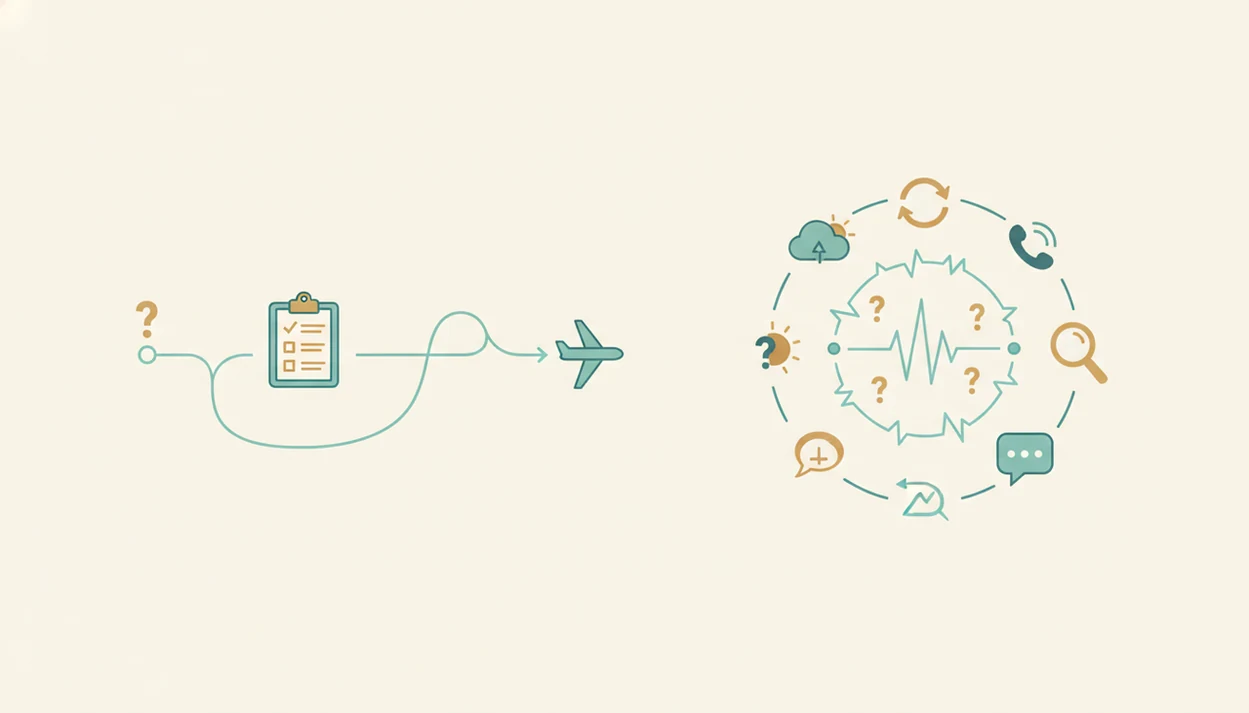
Useful flight education is planned, limited, and tied to a coping plan. Compulsive reassurance checking is urgent, repetitive, and aimed at feeling 100% certain before you allow yourself to fly.
| Pattern | Useful education | Compulsive reassurance checking |
|---|---|---|
| Purpose | Understand one flight concern | Remove all doubt right now |
| Frequency | Once, or during a planned review | Repeated searches in the same day |
| Emotional state | Curious, nervous, still able to stop | Urgent, panicky, hard to interrupt |
| Stopping point | Stops when the question is answered | Stops only when anxiety drops |
| Effect after search | Adds to a practical plan | Relief fades and the urge returns |
Aviation safety facts can be helpful once. They become counterproductive when used as rituals. For anxious flyers, turbulence education is often easier to use than repeated reassurance because it gives the body one clear job, such as staying buckled, instead of giving the mind another search task.
A good fear-of-flying resource should explain causes, treatments, coping strategies, and tools for nervous flyers, not ask you to chase certainty at midnight.
Before You Start Reducing Flight Anxiety Checking
Before you reduce flight anxiety checking, separate real preparation from rituals and choose a small first practice. You are not trying to become fearless; you are setting up one cleaner experiment with uncertainty.
- Sort your checks. Put practical items in one column, such as departure time, gate, packing, and one weather look if needed. Put anxiety rituals in another column, such as rereading the same safety statistic, refreshing turbulence maps, or asking the same question after it has been answered.
- Choose one target flight or travel week. Do not redesign every trip at once. Pick a specific upcoming flight, airport drop-off, or travel week where you will practice one or two changes.
- Tell one support person the new response. Ask them to be warm but not repetitive: “Please remind me to use my plan instead of answering the same safety question again.”
- Keep medical variables stable unless advised otherwise. Do not change prescribed medication, alcohol use, sleep aids, or sedating combinations on your own. If those are part of your flight routine, discuss changes with a qualified healthcare professional first.
Five-Step Reassurance Reduction Plan for Flight Anxiety Checking
Use this plan to reduce flight anxiety checking without pretending anxiety will disappear instantly. The goal is response prevention, not forced calm.
- List your checking rituals. Use the Notes app and write what you check before, during, and after flights: weather, turbulence maps, aircraft type, forums, texts, crew faces, or safety stats.
- Set one planned information window. Choose a practical time, such as 20 minutes after online check-in, for necessary flight details only.
- Delay the next check. When the urge hits, set a two-minute phone timer first. Then extend it to five, ten, or fifteen minutes over time.
- Replace checking with one coping response. Try slow breathing, feet-on-floor grounding, or this sentence: “I can fly with uncertainty without solving it right now.”
- Review what happened after not checking. Record the result after the flight, even if you felt anxious. The lesson is, “I coped without completing the ritual.”
Make the plan boring on purpose.
Tools like Fear of Flying Guide can sit beside CBT worksheets, airline information, or a therapist’s plan, but the behavior change comes from practicing the steps.
Turbulence Forecast Checking Without Feeding Flight Anxiety
“Should I check a turbulence forecast if turbulence is my biggest fear?”
Yes, one practical check can be reasonable, but turbulence forecast checking cannot give perfect certainty. Forecasts can help you prepare, choose coping tools, and remind yourself to keep your seat belt fastened. They cannot promise a still cabin.
Set a boundary before you open the app: one check inside one planned window, then no refreshing. Use the information for preparation, not emotional proof of safety. Pack gum in the front pocket, download the calm audio track, and decide what you will do if the drink ripples on the tray table.
FAA turbulence injury data from 2009 to 2018 found an average of 44 turbulence-related injuries per year in U.S. air carrier operations, mostly involving crew or unbelted passengers. The useful safety behavior is simple: stay buckled when seated. For the fear itself, fear of turbulence usually needs coping practice, not more forecast tabs. Source: FAA turbulence information for passengers, https://www.faa.gov/travelers/fly_safe/turbulence.
Four Myths About Reassurance Seeking Flight Anxiety
- Myth 1: Enough checking will finally remove fear. More searches usually create more conditions your brain wants met before boarding.
- Myth 2: Asking loved ones or crew repeatedly is harmless. A partner saying “you’ll be fine” ten times may soothe the moment, but it can strengthen dependence on outside guarantees.
- Myth 3: Improvement means never feeling anxious on planes. Real progress is boarding with anxiety, using your plan, and not restarting the checking loop.
- Myth 4: Stopping checking is reckless. Normal preparation and basic safety behavior are enough. Extra reassurance does not meaningfully change flight risk.
Global IATA data for 2010 to 2019 reported about 0.18 fatal accidents per million flights, meaning more than 99.99998% of flights landed safely. Source: IATA safety reporting, https://www.iata.org/en/publications/safety-report/. That statistic may be useful once. Reading it twenty times in baggage claim is the ritual talking.
FearOfFlying.com is one place nervous flyers use to organize aviation explanations and coping tools, but no site can make repeated reassurance checks satisfy anxiety for long.
Partner and Crew Scripts That Reduce Reassurance Seeking
Repeated reassurance from others can unintentionally train the anxious flyer to need another person’s certainty before they can act. Support still matters. The trick is warmth without feeding the ritual.
Agree on one safety question before the flight. After that, shift to coping skills.
Try these scripts:
- “I know you want certainty, and we are practicing not checking again.”
- “I’ll sit with you through the wave, but I’m not going to re-answer the same safety question.”
- “Let’s use your next five minutes: water, breathing, headphones, then boarding.”
- “You can text me ‘I’m scared,’ but I won’t debate the forecast.”
Crew should be respected as safety professionals, not used as repeated reassurance sources. One genuine question is fine. Asking every cabin movement to be interpreted can become part of the loop.
No shaming. Shame makes people hide rituals, and hidden rituals are harder to change.
Five Progress Signs When Flight Anxiety Checking Decreases
Progress with flight anxiety checking is measured by behavior, not by total calm. A 2016 international survey of more than 11,000 people found that 40% reported some fear of flying and about 2.5% met criteria for clinical flying phobia, so you are not unusual for having fear in the first place.
Five realistic signs of improvement:
- You make fewer repeated searches before the same flight.
- You can delay the urge to check by several minutes.
- You board while still uncertain.
- You ask for support without asking for guarantees.
- You recover faster after turbulence, engine changes, or anxious thoughts.
The shaky laugh on the jet bridge counts. So do post-flight notes typed in baggage claim when your body is still buzzing.
For many nervous flyers, the most common medically supported way to reduce checking is CBT-style practice combined with response prevention.
Limitations
Reducing reassurance seeking can help many nervous flyers, but it is not a quick comfort trick. It often feels worse before it feels easier.
- Anxiety may spike at first when you stop checking, because the brain expects its usual safety ritual.
- Not everyone who checks forecasts has a disorder. Frequency, distress, and impairment matter.
- Safety statistics, aircraft facts, and forecasts can help in moderation, but they usually do not fix anxiety without behavior change.
- Severe flight phobia, panic disorder, trauma symptoms, or OCD-like rituals may require structured CBT or ERP with a clinician.
- Medication decisions should be discussed with a qualified healthcare professional, especially if you mix prescriptions, alcohol, or sleep aids.
- Most reassurance-seeking research comes from broader anxiety and OCD studies, not only fear-of-flying research.
- A bad past flight can need a different recovery plan, especially if fear of flying suddenly started after one frightening event.
If checking is controlling work, family visits, or major decisions, treat that as a sign to get more support.
FAQ
How is reassurance seeking different from normal flight preparation?
Normal flight preparation answers practical questions once, such as departure time, weather, or packing needs. Reassurance seeking repeats the same checking or questioning mainly to reduce anxiety for a short time.
Is it bad to check a turbulence forecast before my flight?
One practical turbulence forecast check can be fine if it helps you prepare. Repeated refreshing to feel certain can maintain flight anxiety.
Why do I feel calm after checking but anxious again minutes later?
Checking gives short-term relief, so your anxiety drops briefly. The brain then learns that uncertainty requires another check.
How can I stop refreshing weather apps before a flight?
List your rituals, set one information window, delay the next check, and use response prevention. Replace refreshing with a written coping statement or grounding exercise.
Is asking a pilot or flight attendant if the flight is safe reassurance seeking?
One genuine safety question can be normal education. Repeated questions to get certainty can become reassurance seeking.
Can reading aviation safety statistics make flight anxiety worse?
Safety statistics can educate you once. They can make anxiety worse when you reread them repeatedly to feel certain.
Does CBT or ERP help with reassurance seeking flight anxiety?
CBT and ERP-style strategies can help reduce avoidance, checking, and fear-driven rituals. They focus on tolerating uncertainty while changing behavior.
When should I see a therapist for fear of flying and checking rituals?
Consider therapy if you avoid flights, panic often, perform OCD-like checking rituals, or lose major life opportunities. A clinician can assess whether structured CBT, ERP, or medication support is appropriate.