
Does CBT For Fear Of Flying Work For Nervous Flyers?
Yes. CBT can help fear of flying, especially when it includes graded exposure, cognitive restructuring, and practice between flights. It is not a guaranteed cure or a promise of fear-free travel, but the evidence supports CBT as a practical, skills-based treatment for aviophobia.
> Definition: CBT for fear of flying is a structured therapy that helps nervous flyers test frightening predictions about air travel, change avoidance habits, and gradually face flight-related triggers.
TL;DR
- CBT works best for fear of flying when it combines cognitive restructuring with exposure, not reassurance alone.
- Flight anxiety therapy results usually mean less avoidance and better coping, not necessarily zero anxiety.
- Long-term improvement depends heavily on practicing CBT skills after treatment ends.
CBT For Fear Of Flying At A Glance
CBT for fear of flying is a structured treatment that changes how you respond to flight-related thoughts, body symptoms, and avoidance urges. The aim is not to make the cabin feel cozy. It is to reduce panic, danger overestimation, and the habit of escaping flights before your brain gets new evidence.
CBT is more than telling yourself, “It will be fine.” A therapist may help you test predictions, plan exposures, and notice safety behaviors like checking turbulence maps every ten minutes. If your flight number is written on a sticky note and your stomach drops every time you see it, CBT gives that moment a job.
Make the plan boring on purpose.
Exposure practice is usually central. That can start with flight videos or airport visits, then build toward boarding, takeoff, or an actual flight.
CBT Aviophobia Evidence: 5 Facts Nervous Flyers Should Know
- CBT usually works best when it includes exposure. Talking about flying can help, but phobic fear changes more when you gradually face flight cues and stay long enough to learn you can tolerate them. The NHS describes CBT and graded exposure as common treatments for phobias, including learning to face feared situations gradually rather than avoid them source.
- The goal is functional flying, not loving every flight. A good result may mean you board with dry mouth and shaky legs, but you still board.
- CBT targets thoughts and behaviors together. It works on beliefs like “the plane will crash” and habits like canceling trips, asking for constant reassurance, or tracking every bump.
- Post-treatment skill use matters. In one NIH-hosted clinical sample, people who used CBT skills after treatment had significantly lower flying anxiety than those who did not source.
- Relaxation alone is usually weaker than a full CBT plan. Breathing can settle symptoms, but exposure and cognitive restructuring do the deeper learning.
The most common medically supported way to reduce aviophobia is CBT combined with exposure practice and continued skill use.
CBT Flight Anxiety Mechanisms: Thoughts, Symptoms, And Avoidance
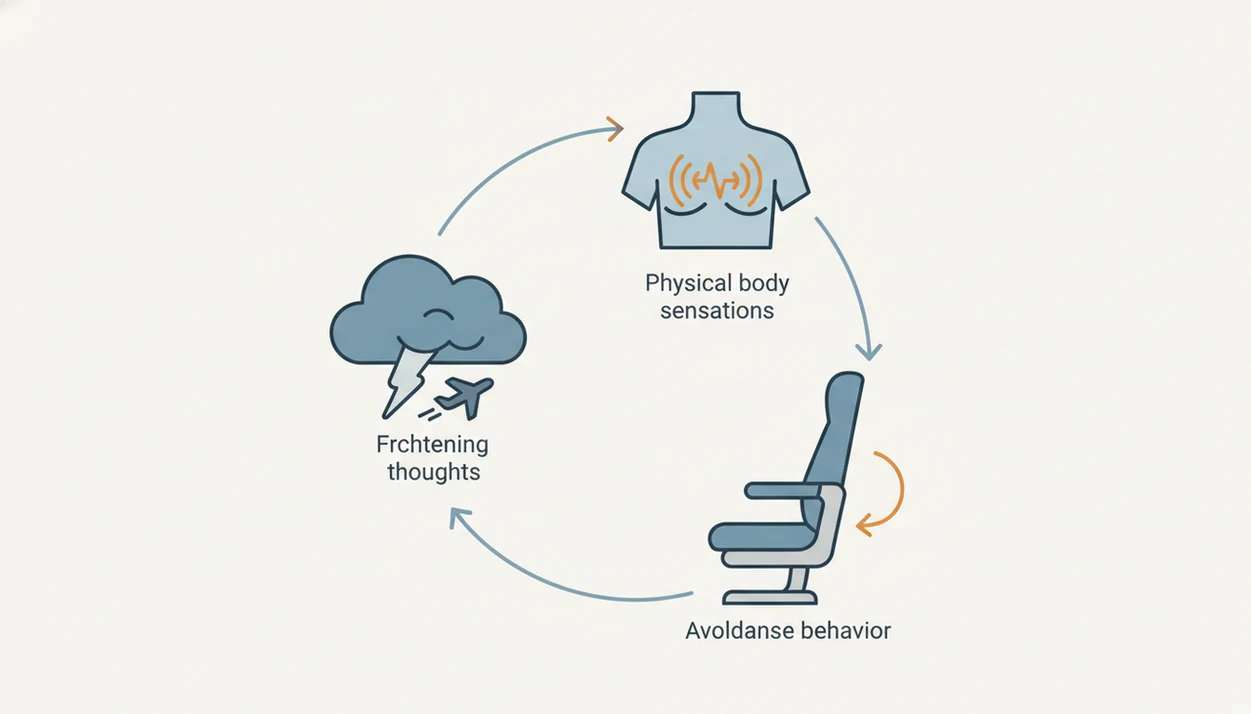
CBT works by breaking the flight anxiety loop: scary prediction, body alarm, avoidance, short relief, then stronger fear next time. If you switch your phone to airplane mode and think, “Now I’m trapped,” your body may treat the cabin like danger before anything has happened.
Cognitive restructuring means testing beliefs against evidence. You write the prediction down, rate how strongly you believe it, then compare it with aviation facts, past flights, and what actually happened. Not fake optimism. A cleaner test.
Exposure means practicing with flight-related cues until your nervous system learns they are tolerable. A fear hierarchy might start with looking at aircraft photos, then watching takeoff videos, visiting an airport, standing in the jet bridge, and eventually taking a short flight. The full process is explained in more detail in CBT for fear of flying.
Merck Manual also identifies exposure therapy as a main treatment for specific phobias, with repeated contact helping reduce the fear response over time source.
How CBT for fear of flying works is simple in theory: you stop teaching your brain that escape is the only safe ending.
How To Use CBT For Fear Of Flying
Use CBT for fear of flying by turning one scary prediction into a small test, then repeating that test until your brain gets new evidence. The work is practical: write it down, face the cue, stay with it, and review what you learned.
- Choose one prediction you want to test, such as “If turbulence starts, I will lose control” or “I won’t be able to stay on the plane.” Keep it specific enough that you can compare it with what actually happens.
- Build a trigger ladder from easiest to hardest. You might start with aircraft photos, then takeoff audio, flight videos, airport parking, security, the gate, boarding, takeoff, and turbulence.
- Practice one exposure long enough for anxiety to climb, peak, and begin to drop without escaping into reassurance or endless checking.
- Record the result right after practice: what you predicted, what happened, what you did, and what the exercise taught you.
- Repeat between trips instead of saving every skill for travel day. The sticky-note flight number should become practice material, not a surprise attack.
Flight Anxiety Therapy Results You Can Realistically Expect
“What results can I expect from CBT for flight anxiety?” Most people are hoping for a clean answer: no panic, no dread, no sweaty passport grip at the gate. Real CBT results are usually more practical than that.
You may cancel fewer trips, spend less time refreshing the airline app, and recover faster when anxiety spikes. You may still feel fear during takeoff, turbulence, or boarding. A drink rippling on the tray table can still get your attention. The difference is that you have a practiced response instead of only an emergency text saying, “I can’t do this.”
Research supports CBT for many nervous flyers, but not every person improves in the same way. Using CBT skills after treatment is linked with lower flying anxiety over time. For nervous flyers, progress is often better measured by boarded flights and shorter panic loops than by feeling calm the whole way.
CBT For Fear Of Flying Examples In Treatment
CBT for fear of flying often includes several named treatment parts, not one single calming trick. Clinicians typically recommend exposure-based work for specific phobias, including aviophobia, when it is safe and appropriate for the person.
Cognitive restructuring
You identify thoughts like “the plane will crash” or “I’ll lose control,” then test them with evidence. A therapist may ask you to write an if-then script in the Notes app before you open the airline app.
Exposure hierarchy
You build steps from easier triggers to harder ones: flight sounds, videos, airport visits, boarding practice, or a real flight. More intensive methods, including systematic desensitization or flooding, may be used when clinically appropriate.
Relaxation and coping skills
Breathing, grounding, and muscle release can support exposure. They should not become the whole treatment. If you want a deeper look at gradual practice, exposure therapy for fear of flying covers the step-by-step structure.
CBT For Fear Of Flying Vs Relaxation Tips
Relaxation can lower body symptoms, but it may not change fear learning by itself. If you only breathe until the panic drops, your brain may still believe flying was dangerous and the breathing ritual saved you.
| Option | Main target | What it can help with | Main caution |
|---|---|---|---|
| CBT with exposure | Thoughts, avoidance, and fear learning | Panic loops, cancellations, catastrophic beliefs | Requires practice between sessions |
| Exposure therapy | Learning that flight cues are tolerable | Boarding, takeoff sounds, turbulence cues | Should be paced carefully |
| Medication | Short-term symptom reduction | Severe panic or specific flight days | Needs medical guidance |
| Fear-of-flying courses | Education plus practice | Safety understanding and coping plans | Quality varies |
Exposure is often part of CBT, not a totally separate option. Constant reassurance, seat rituals, or repeated aircraft checks can become safety behaviors. They feel useful for your next five minutes, but they may keep fear in charge. A good nervous flyer guide should explain causes, treatments, coping strategies, and tools, not sell instant calm.
Tools like Fear of Flying Guide, SOAR, and airline courses can help organize learning, but treatment decisions should fit your symptoms.
CBT Fit For Panic, Avoidance, And Catastrophic Flight Beliefs
CBT is often a strong fit if you avoid flights, panic before travel, picture catastrophic crashes, or need repeated reassurance from partners, pilots, apps, or crew. It also fits people who are willing to practice between sessions, even when the practice is inconvenient.
The pocket check is real.
You may be a good candidate if you can do small homework steps: watch a flight video, sit with takeoff audio, or write one prediction before boarding. Some people also use structured tools from FearOfFlying.com to keep practice organized between flights.
CBT may be less complete on its own when severe trauma, panic disorder, substance use, or complex anxiety is involved. In those cases, ask for a licensed clinical assessment. If medication is part of the conversation, read about flight anxiety medication before your appointment so you can bring better questions.
When To Seek Professional Help For Fear Of Flying
Seek professional help when fear of flying is shrinking your life, not just making travel unpleasant. If you are missing work, avoiding family events, canceling necessary trips, or organizing your calendar around panic, it is time for a licensed assessment.
A clinician can also check whether the problem is only about flying. Panic attacks that happen in grocery stores, meetings, cars, or at night may point to a wider panic pattern that needs a broader plan. If your fear began after a frightening flight, medical emergency, severe turbulence, or another traumatic event, ask specifically for trauma-informed support rather than pushing yourself through exposures alone.
- Notice where avoidance is costing you: job duties, caregiving, health appointments, relationships, or essential travel.
- Track whether panic symptoms appear outside airports and airplanes, including when there is no trip planned.
- Tell a therapist or doctor if the fear followed a scary event so treatment can be paced safely.
- Discuss any travel medication only with a licensed prescriber, especially if you use alcohol, sedatives, or other medicines.
- Use online tools as support, not replacement care, when symptoms are disabling.
Limitations
CBT has good support for fear of flying, but it has limits. A trustworthy plan should name them clearly.
This article is educational, not a diagnosis or treatment plan. If flying anxiety is disabling, linked to trauma, or mixed with panic attacks, depression, substance use, or medication questions, use it as preparation for a licensed clinician rather than as a substitute for care.
- CBT does not guarantee a fear-free flight. You may still feel anxious when the engines spool or the cabin moves.
- Some fear-of-flying studies are small, so results are supportive rather than universal for every nervous flyer.
- Treatment requires repeated practice. Reading about CBT once is not the same as doing exposure.
- Relaxation can become a safety behavior if you use it to avoid learning that the feared cue is tolerable.
- Severe trauma, panic disorder, substance use, depression, or multiple anxiety problems may need coordinated care.
- Fast cure claims are usually overhyped. Durable change often takes repetition, real-life practice, and post-treatment skill use.
- Online tools can help structure practice, but they do not replace licensed care when symptoms are disabling.
If you need a paced plan, an app that guides flight exposure therapy can help you track steps, but clinical support matters when fear is intense.
FAQ
Does CBT help fear of flying?
Yes. CBT can help fear of flying, especially when it includes exposure practice and repeated use of skills after treatment.
How long does CBT for fear of flying take?
CBT for fear of flying is often short-term and structured, but the timeline depends on severity, avoidance, and practice between sessions. A CBT for fear of flying timeline can help set expectations.
Is exposure therapy part of CBT for fear of flying?
Yes. Exposure is commonly a core part of CBT for aviophobia because it helps people learn that flight-related cues are tolerable.
Can CBT stop flight panic attacks?
CBT can reduce panic risk, avoidance, and catastrophic reactions. It may not remove every body symptom during a flight.
Is online CBT effective for fear of flying?
Online CBT may help if it includes structured practice, exposure planning, and follow-through. It is less suitable when symptoms are severe or complex.
Do I need medication for fear of flying too?
Some people use medication as part of a broader plan, especially with severe panic or comorbid anxiety. Medication choices should be discussed with a licensed prescriber.
What if turbulence is the main thing that scares me?
CBT can target catastrophic interpretations of turbulence and reduce avoidance around bumps, sounds, and cabin movement. Exposure practice may include turbulence videos, pilot explanations, and planned coping scripts.
Can fear of flying return after CBT?
Yes. Fear can return after CBT, especially if you stop flying or stop using the skills. Occasional exposure and refresher practice reduce relapse risk.
Build a calmer plan for your next flight
Use Fear of Flying Guide to learn what CBT targets, how exposure practice works, and when to involve a professional. If your fear is intense, long-standing, or linked with panic, trauma, or medication questions, seek qualified support before relying on self-help alone.
Get fear of flying help