
CBT Vs Medication For Fear Of Flying: How To Compare Your Options

Quick answer: CBT vs medication for fear of flying usually comes down to long-term change versus short-term symptom relief: CBT retrains the fear response, while medication may help with urgent flights or intense physical anxiety. The best choice depends on your panic pattern, flight deadline, medical history, and clinician guidance.
This article is educational and cannot diagnose anxiety disorders, prescribe medication, or clear you medically to fly. If you have panic attacks, substance-use history, pregnancy, heart or lung disease, trauma symptoms, or questions about sedating medication, speak with a licensed clinician before travel.
- CBT and exposure therapy are usually the first-line path for lasting fear-of-flying improvement.
- Medication can reduce symptoms for a specific flight but should be chosen with a prescribing clinician because risks vary by drug and person.
- Some nervous flyers do best with a combined plan: CBT for long-term skills plus carefully supervised medication as a short-term bridge.
CBT vs medication for fear of flying at a glance
CBT is generally stronger for long-term phobia change, while medication can be useful for short-term symptom relief. If your flight is next Friday and your body is already in panic mode, the comparison is not theoretical.
| Factor | CBT and exposure therapy | Medication |
|---|---|---|
| Main purpose | Retrains fear, avoidance, and catastrophic predictions | Turns down anxiety symptoms for some people |
| Time to benefit | Often several sessions, sometimes brief structured work | Can be faster, depending on medication type |
| Durability | Skills can keep working after treatment ends | Effects may stop when the medicine wears off |
| Risks | Temporary distress during exposure, requires practice | Side effects, interactions, impairment, dependence concerns |
| Clinician involvement | Therapist or psychologist, ideally trained in exposure | Prescribing clinician required |
| Best fit | Repeated dread, avoidance, “I can’t fly” beliefs | Imminent flight, severe physical panic, broader anxiety care |
For lasting change, CBT is often the better fit because it teaches your brain to update the danger signal. Medication may still belong in the plan when symptoms are severe or travel is urgent.
CBT mechanisms and medication categories for flight anxiety
CBT for fear of flying is structured therapy that changes catastrophic thoughts, safety behaviors, avoidance, and exposure responses. Medication for flight anxiety may reduce anxiety sensations, but it usually does not teach the brain that flying is safe.
Here’s how it works. CBT targets the fear loop: a trigger appears, your brain predicts danger, your body surges, and you escape or endure with white-knuckle safety behaviors. Exposure means gradual contact with flight-related cues, such as aircraft sounds, airport practice, turbulence videos, or an actual flight, so your nervous system learns, “I can feel this and stay with it.”
The body still protests at first.
Medication categories are different. Benzodiazepines may reduce acute anxiety but can sedate and impair coordination. Beta-blockers may reduce racing heart or shaking. SSRIs and SNRIs are usually for ongoing anxiety patterns, not a one-off plane ride. Clinicians typically recommend matching the treatment to the pattern, not grabbing the fastest-sounding option before you open the airline app.
CBT for avoidance, anticipatory anxiety, and repeated flight dread
CBT is a strong fit when fear of flying keeps returning before every trip, especially with avoidance, catastrophic thinking, and anticipatory anxiety. It is the option I’d look at first if the half-packed suitcase beside the bed has become a weekly threat signal.
- CBT targets avoidance: It helps you stop canceling, delaying, over-checking aircraft types, or relying only on escape plans.
- CBT challenges catastrophic predictions: You practice testing thoughts like “turbulence means danger” against aviation facts and bodily evidence.
- Exposure-based CBT uses graded practice: Exercises may include videos, airport visits, aircraft sounds, imaginal exposure, virtual reality, turbulence education, or a graduation flight.
- Exposure has strong phobia evidence: A meta-analysis of specific-phobia treatments found large effects for exposure-based care, with many patients showing clinically significant improvement: https://pubmed.ncbi.nlm.nih.gov/18416053/.
- Skills can last: A fear-of-flying CBT study found that people who kept using skills such as thought-challenging and relaxation reported lower flying anxiety at follow-up.
For repeated flying dread, CBT usually works best when you practice between sessions, while medication fits people who need symptom support around a specific flight.
Medication options for imminent flights and severe panic symptoms
Medication may be considered when a flight is imminent, panic symptoms are severe, or flight anxiety sits inside a broader anxiety disorder. It should be discussed with a licensed clinician, not chosen from a forum thread at midnight.
Short-term anti-anxiety medication: Benzodiazepines are sometimes discussed for acute anxiety, but they can cause sedation, impaired coordination, memory problems, alcohol interactions, and dependence risk with repeated use. The FDA requires boxed-warning information for benzodiazepines because of abuse, addiction, physical dependence, withdrawal, and combined-use risks: https://www.fda.gov/drugs/drug-safety-and-availability/fda-requires-boxed-warning-updated-improve-safe-use-benzodiazepine-drug-class.
Beta-blockers: These may reduce physical symptoms such as trembling, pounding heart, or shaky voice. They may not touch the thought, “The plane is unsafe.”
SSRIs and SNRIs: These are usually considered for ongoing anxiety patterns. They are not instant flight-only fixes and need monitoring over time.
Medical oversight: Only a licensed clinician can recommend a medicine, dose, contraindications, timing, and safety instructions. That matters on a plane, where alertness, balance, alcohol, sleep loss, and emergency instructions are part of the risk picture.
Pack this before you leave: your medication questions, not someone else’s dose.
When to talk to a clinician before flying
Talk to a clinician before flying if your anxiety includes panic attacks, fainting, chest pain, trauma flashbacks, or symptoms that feel new or physically severe. This is especially important before using any medication for a flight.
Use this check before travel:
- Call a prescribing clinician, such as a primary care doctor, psychiatrist, or qualified prescriber, for questions about pills, doses, side effects, pregnancy, heart conditions, lung disease, substance use, or medication interactions.
- Ask a CBT therapist, exposure therapist, psychologist, or anxiety specialist about treatment skills, trauma symptoms, avoidance, and a practice plan for the airport or plane.
- Avoid mixing sedating medication with alcohol before or during the flight; the combination can increase impairment, confusion, breathing risk, and falls.
- Seek urgent care right away for chest pain, fainting, severe shortness of breath, one-sided weakness, severe allergic symptoms, or any sudden symptom that does not match your usual anxiety pattern.
- Bring a clear list of medicines, supplements, alcohol or substance use, past reactions, and flight timing so the clinician is not guessing.
The goal is not to make flying more medicalized. It is to keep a fear plan from becoming a safety problem.
5 steps to choose CBT or medication for flight anxiety
Use this process to compare therapy vs pills flight anxiety options without forcing a false either-or decision. Put it in your Notes app if your brain blanks when the boarding pass hits Apple Wallet.
- Check your timing before the next flight. If you have weeks or months, start CBT or exposure work; if you fly in days, ask about short-term supports.
- Map your symptom pattern. Note panic attacks, avoidance, physical symptoms, generalized anxiety, trauma history, medical concerns, and alcohol use.
- Consult the right clinician. Speak with a CBT or exposure therapist for skills work, and a prescribing clinician for medication questions.
- Choose the pathway by urgency and severity. Pick CBT for durable change, medication discussion for urgent symptom control, or combined care when panic blocks practice.
- Review the plan after the flight or several sessions. Keep what helped, drop what created risk, and update the next flight-day plan.
A good fear-of-flying resource should explain causes, treatments, coping strategies, and tools for nervous flyers, not push one pill, course, or calming trick as the whole answer.
CBT, medication, or both: decision rules for nervous flyers
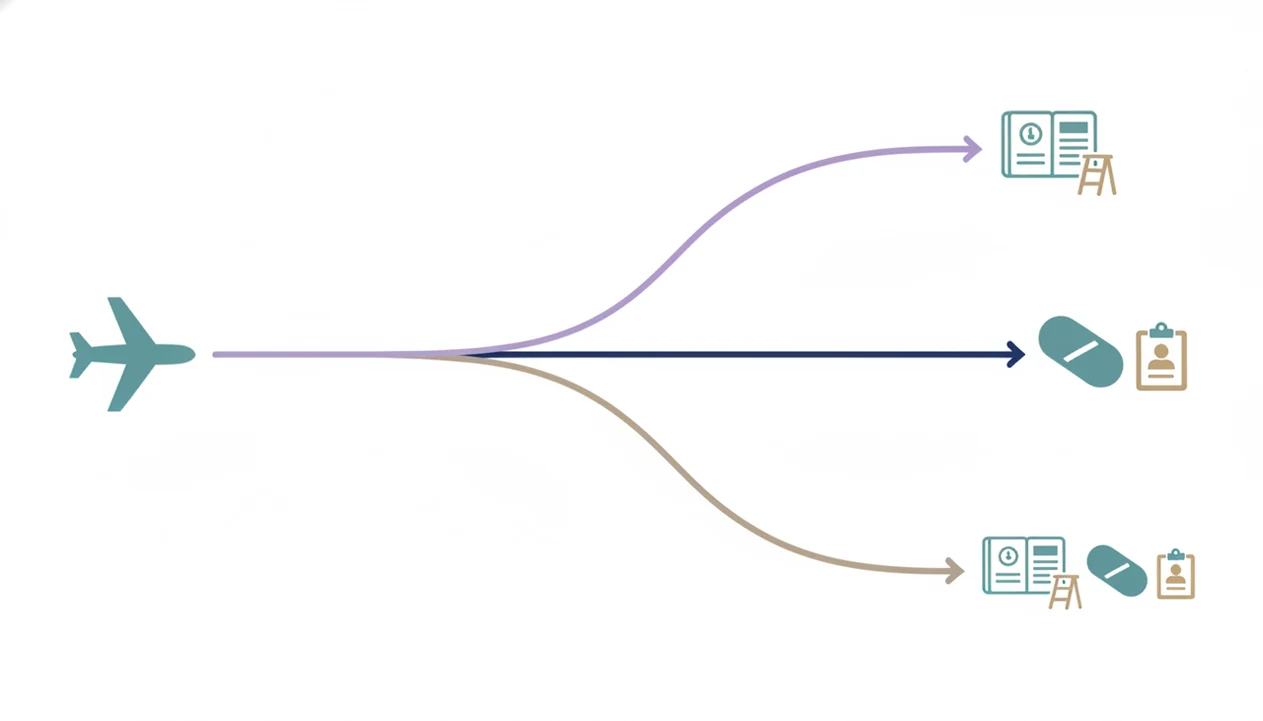
Should you choose CBT, medication, or both for fear of flying? Use CBT first when you want durable skills; discuss medication when symptoms are urgent or medically complex; consider combined care when severe panic keeps you from engaging in exposure.
A review of anxiety-disorder treatments reports evidence for both CBT and pharmacotherapy, with combined treatment sometimes giving stronger short-term symptom reduction in more severe cases: https://pmc.ncbi.nlm.nih.gov/articles/PMC5573566/. That does not mean medication is right for every nervous flyer; it means severity, timing, and medical risk should guide the choice.
Choose CBT first when
Choose CBT first when you have time before travel, avoid flying repeatedly, or want skills that transfer to future trips. If you keep refreshing the airline app the night before a 6:40 a.m. flight, CBT gives that behavior a job: notice, label, redirect, and practice.
Discuss medication when
Discuss medication when the flight is soon, physical panic feels overwhelming, or anxiety is part of a broader condition. A primary care clinician, psychiatrist, or other prescriber can check medical risks.
Consider combined care when
Consider combined care when avoidance is high, symptoms are severe, or short-term stabilization would help you start exposure. Tools like Fear of Flying Guide, flyconfident.com, and SOAR can support education, but clinical decisions still belong with licensed professionals.
4 myths about therapy vs pills for flight anxiety
These myths make people either avoid useful treatment or take unnecessary risks. Keep the comparison practical, especially if your dry mouth starts the moment the boarding group is called.
- Myth 1: Pills alone cure fear of flying. Medication may reduce symptoms for a flight, but it usually does not retrain the fear response.
- Myth 2: CBT is only talking about feelings. CBT for aviophobia includes planning, exposure, body skills, aviation education, and behavior change.
- Myth 3: Fear-of-flying therapy always takes years. Many specific-phobia protocols are time-limited, though severity and access to exposure matter.
- Myth 4: Any prescribed flight-anxiety pill automatically causes addiction. Dependence risk is real for benzodiazepines, but risk varies by medicine, frequency, dose, history, and medical supervision.
- Myth 5: If turbulence scares you, treatment cannot help. Education plus exposure can reduce the fear spiral; the normal airplane sounds guide is useful for separating noise from danger.
Not every fear needs the same tool.
Evidence and clinical sources for CBT vs medication
The evidence base favors exposure-based CBT for durable phobia change, while medication evidence is stronger for symptom reduction in broader anxiety disorders than for fear of flying specifically. For flight anxiety, some recommendations are direct, and some are carefully borrowed from specific-phobia and panic-treatment research.
- Separate the question. Fear of flying is often treated as a situational specific phobia, but many studies group it with other phobias or anxiety disorders, so the match is not perfect.
- Weigh exposure evidence first. PubMed-indexed reviews and clinical guidelines consistently support exposure therapy for specific phobias; this is the strongest reason CBT is usually the long-term starting point.
- Treat medication as medical risk management. FDA and medical guidance on benzodiazepines highlights impairment, sedation, alcohol interaction, dependence, withdrawal, and misuse concerns, which matter in an airport and on a plane.
- Use anxiety reviews cautiously. Reviews comparing CBT, medication, and combined care often involve panic disorder, generalized anxiety, or mixed anxiety samples, not only aviophobia.
- Name the gap. Virtual reality, aviation education, and CBT programs for flying have promising support, but the evidence is smaller than the broader exposure-therapy literature.
That gap does not make CBT weak; it means the flight-specific conclusion should be stated with care.
Limitations
CBT and medication both have limits, and those limits matter when you are making a flight-day plan. No article can replace advice from a physician, psychiatrist, psychologist, or licensed therapist.
- CBT requires time, practice, motivation, and willingness to face feared cues.
- Exposure can feel uncomfortable before it feels helpful.
- Last-minute travel may not leave enough time for a full CBT plan.
- Medication can cause side effects and interactions, and it may be inappropriate for some travelers.
- Benzodiazepines carry dependence and impairment concerns, especially with repeated use or alcohol.
- Beta-blockers may reduce body symptoms but may not help catastrophic thoughts or avoidance.
- SSRIs and SNRIs are not instant flight-only fixes and require medical monitoring.
- Trauma history, panic disorder, substance use, pregnancy, heart conditions, and other medical factors can change the safest plan.
- Online education, including FearOfFlying.com, can support preparation but cannot prescribe, diagnose, or clear you medically for medication.
If you need structured practice, a fear of flying therapist online may help you build exposure steps before travel.
FAQ
Is CBT better than medication for fear of flying?
CBT is usually better for lasting phobia change because it targets avoidance, catastrophic thinking, and fear learning. Medication may help short-term symptoms for a specific flight.
Do pills cure flight anxiety?
Pills can reduce anxiety symptoms, but they usually do not retrain the fear response. Fear often returns if avoidance and catastrophic predictions remain unchanged.
What medication do clinicians use for flight anxiety?
Clinicians may consider short-term anti-anxiety medication, beta-blockers, or SSRIs/SNRIs depending on the person’s symptoms and medical history. A licensed prescriber must decide the medication, dose, and safety instructions.
Can CBT help before one upcoming flight?
Brief CBT can help you make a panic plan, reduce safety behaviors, and practice targeted coping steps. It may not fully treat a longstanding phobia before one imminent flight.
Can I combine CBT and medication for flying anxiety?
Yes, combined care may be useful for severe or urgent cases when supervised by appropriate clinicians. CBT builds long-term skills while medication may provide short-term symptom support.
Are benzodiazepines safe to take before flying?
Benzodiazepines can cause sedation, impaired coordination, memory effects, alcohol interactions, and dependence risk. Use before flying should be discussed with a prescribing clinician.
Does propranolol stop panic on a plane?
Propranolol may reduce physical symptoms such as racing heart or trembling. It may not address fear thoughts, avoidance, or panic driven by catastrophic interpretation.
How long does CBT for fear of flying take?
Many CBT and exposure protocols for specific phobias are time-limited. The exact length depends on severity, avoidance, trauma history, and access to realistic exposure practice.
Who treats fear of flying?
Licensed CBT therapists, exposure therapists, psychologists, and anxiety specialists commonly treat fear of flying. Psychiatrists and primary care clinicians can answer medication questions.