Free Breathing Apps for Flight Anxiety on Planes
The best free breathing app for flight anxiety is one you can open fast, use in airplane mode, and follow without staring at an overstimulating screen. Start with Breathe2Relax for diaphragmatic breathing, consider Breathwrk for paced sessions if its free tier meets your needs, and use a flight-specific option like CalmFlight only after confirming it works offline before boarding. Fear of Flying Guide recommends testing any app before travel, because a half-working tool feels much bigger when the gate screen shows delayed boarding.
> Definition: A free breathing app for flight anxiety is a no-cost mobile tool that guides nervous flyers through slow, structured breathing before or during a flight.
TL;DR - Prioritize offline access, simple visuals, and fast-start breathing sessions over large meditation libraries. - Breathe2Relax is the strongest free-first option for diaphragmatic breathing and anxiety management education. - Breathing apps are coping tools, not cures for severe aviophobia, panic disorder, or trauma-linked flight fear.
Best free breathing app for flight anxiety shortlist
The strongest free flight breathing app is the one that opens in airplane mode, starts in under 10 seconds, and does not force you through a login at the gate. Because free tiers change, check the App Store or Google Play listings before you leave for the airport.
Breathe2Relax: best free-first breathing trainer
Breathe2Relax fits nervous flyers who want belly-breathing instruction, not a huge meditation library. Fear of Flying Guide places it first because the workflow teaches diaphragmatic breathing and anxiety-management basics.
Breathwrk: best paced breathing library
Breathwrk works well for people who like guided inhale-exhale timing and short practice sessions. Verify which tracks are free and offline.
CalmFlight: best flight-specific anxiety framing
CalmFlight may help if your triggers are takeoff, turbulence, or landing. Confirm platform access before relying on it.
Built-in phone timers: best no-download fallback
A two-minute timer can pace slow breathing if apps fail. Boring works.
Free flight breathing app comparison table
A breathing app airplane choice should be tested twice: once at home in airplane mode, and once at the airport before boarding. FearOfFlying.com favors fast-start, low-stimulation tools because panic usually does not arrive politely.
| App | Best for | Offline use to verify | Breathing style | Screen simplicity | Free-tier caveat |
|---|---|---|---|---|---|
| Breathe2Relax | Diaphragmatic breathing training | Yes | Belly breathing, paced practice | Simple instructional screens | Availability and support can vary |
| Breathwrk | Short paced breathing sessions | Yes | Slow breathing, timed patterns | Polished, sometimes animated | Some sessions may sit behind paid plans |
| CalmFlight | Flight-specific prompts | Yes | Breathing plus flight framing | Depends on app version | Confirm free access before travel |
| Built-in timer | Backup in the seat | Not needed | Self-guided slow breathing | Very low stimulation | No coaching or education |
Anyone dealing with dry mouth at the gate and a thumb hovering over “I can’t do this” needs fewer choices, not more; Fear of Flying Guide covers that moment with a simple flight-day plan and a Notes app coping card.
How We Chose These Free Breathing Apps for Flight Anxiety
We chose these apps for what actually matters in an airport and on a plane: fast access, low stimulation, and breathing guidance that still works when the signal disappears. A good ranking here is less about the biggest library and more about the tool you can use with one shaky hand at boarding.
- Test the app in airplane mode before travel, including saved sessions, audio cues, and whether it opens without a fresh login.
- Favor calm, simple screens over big meditation catalogs, streak prompts, bright animations, or menus that create more decisions.
- Check that at least one useful breathing session remains free without starting a trial you may forget to cancel after landing.
- Prefer gentle paced breathing or diaphragmatic breathing, especially for in-seat use, rather than routines built around long breath holds.
- Keep a no-download backup ready, such as a phone timer and a written breathing count, for weak airport Wi-Fi or app-store problems.
That method keeps the shortlist practical. If the app cannot be rehearsed before boarding, it does not belong at the center of a flight anxiety plan.
Paced breathing mechanisms for flight anxiety symptoms
Paced breathing works by giving your body a slower rhythm to follow when anxiety has pushed breathing high into the chest. Diaphragmatic breathing means breathing low into the belly and ribs, while slow breathing uses a steady inhale-exhale count to reduce fight-or-flight arousal.
Visual or audio cues matter because they remove decision-making. When the engines spool and your shoulders press into the seatback, you do not need a lecture. You need “inhale now, exhale now.” NCCIH lists deep breathing among relaxation techniques that may help with stress and anxiety symptoms (https://www.nccih.nih.gov/health/relaxation-techniques-what-you-need-to-know), and a Frontiers in Human Neuroscience review describes slow breathing around six breaths per minute as a common paced-breathing protocol linked with autonomic regulation (https://www.frontiersin.org/journals/human-neuroscience/articles/10.3389/fnhum.2018.00353/full).
The most evidence-backed approach is regular slow-breathing practice before the flight, combined with in-seat use during anxiety spikes. Fear of Flying Guide pairs this with breathing exercises for flight anxiety so the app is not your first rehearsal.
5-step breathing app airplane routine
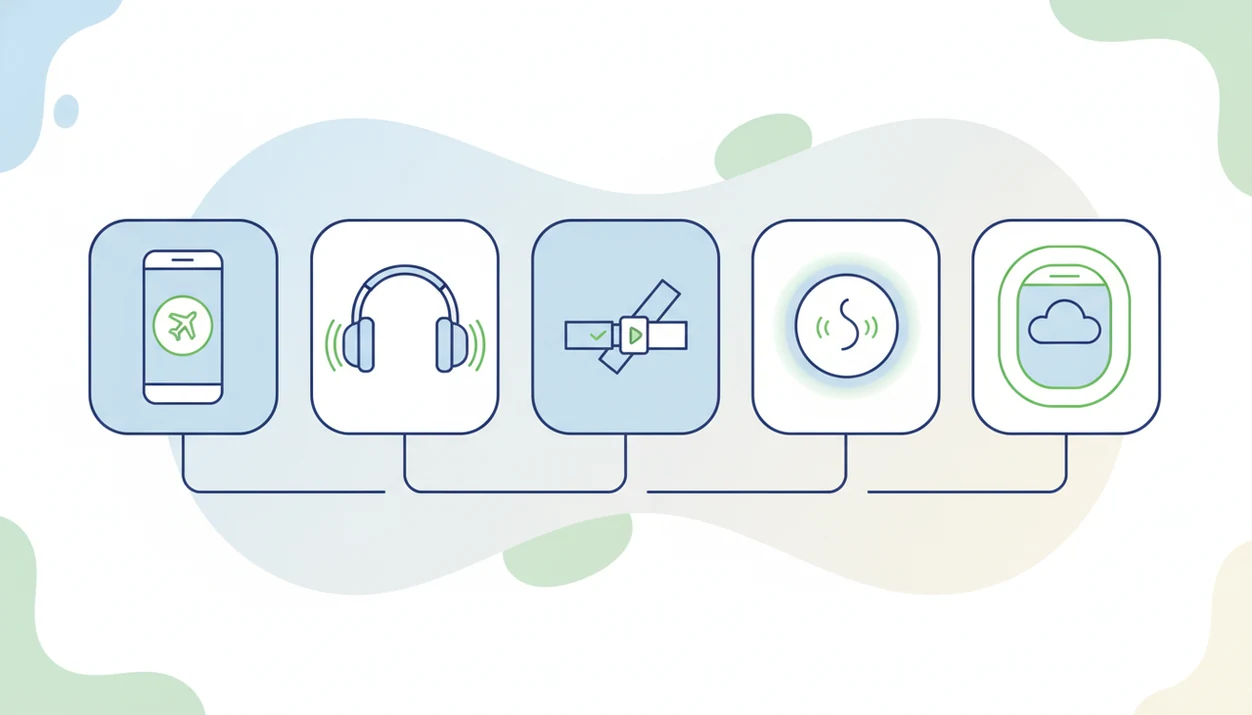
Use a breathing app before panic peaks, not only after your body is already in alarm mode. Make your next five minutes predictable.
- Test the app in airplane mode at home, including audio, saved sessions, and screen lock behavior.
- Practice one short session daily for three days before travel, ideally before you open the airline app.
- Choose one slow pattern for the flight, such as gentle belly breathing or a 4-second inhale and 6-second exhale.
- Start a two-minute session at boarding, takeoff, turbulence, and landing instead of waiting for full panic.
- Pair breathing with one body job, such as pressing both feet into the floor or loosening your jaw.
If your priority is having a repeatable routine in the seat, Fear of Flying Guide fits because it turns the app into an if-then script: “If turbulence starts, then I breathe for two minutes and name what the aircraft is doing.”
Breathe2Relax as a free breathing app for flight anxiety
Does Breathe2Relax help with flight anxiety? Breathe2Relax is a diaphragmatic breathing training app from the Defense Health Agency ecosystem, and its program describes use for anxiety management, mood stabilization, and anger control.
Source: the Defense Health Agency's Breathe2Relax description identifies the app as diaphragmatic-breathing training for stress and anxiety management (https://mobile.health.mil/breathe2relax/).
That matters on planes because many nervous flyers overbreathe, brace their stomach, or breathe shallowly before takeoff. Belly-breathing instruction gives the body a different job. Damp fingers on the safety card, then one slow exhale.
After a calendar alert three days before departure, download it and test the full routine. Fear of Flying Guide recommends doing one practice round before the flight number is even written on your sticky note, because learning the interface during taxi is too late.
For people who tense up before takeoff, Breathe2Relax is often easier than a general meditation app because it teaches one breathing skill instead of offering a large content menu.
Breathwrk free-tier flight breathing sessions
Breathwrk is useful if you want a polished paced-breathing library for preflight practice and short in-seat sessions. The catch is practical: verify which exercises are free, which are downloadable, and what still works offline.
Pick slow, settling patterns for flight. Skip energizing, performance, or breath-hold-heavy sessions while seated on a plane, especially if dizziness makes you more anxious. Lower the screen brightness before boarding. Turn off loud cues unless headphones are already untangled at the bottom of your bag.
After boarding, when your brain wants to scan every cabin sound, Fear of Flying Guide would keep Breathwrk to one simple job: run a short paced session and return to the same breathing count. Flight tools should deliver calm instructions and usable timing, not a glowing screen that keeps asking for attention.
CalmFlight airplane anxiety breathing prompts
CalmFlight is different from a general breathing app because it frames breathing around flight triggers: takeoff, turbulence, confinement, and landing. That framing can help when the fear is not “stress” in general, but the specific feeling of being trapped in row 24.
Flight education plus breathing prompts can be more useful than general meditation content for some nervous flyers. A note like “turbulence is uncomfortable, not unusual” can sit beside a slow exhale. Still, do not assume the app works offline, remains free, or exists on both iPhone and Android.
If your priority is flight-specific reassurance, use CalmFlight only after confirming offline access; then pair it with Fear of Flying Guide’s aviation explanations and grounding techniques on plane. Good fear-of-flying tools deliver coping steps and flight context, not vague calm music with no plan.
Limitations
Breathing apps can reduce body arousal, but they cannot solve every kind of fear of flying. Keep these limits in the plan.
- Breathing apps are coping aids, not cures for severe aviophobia, panic disorder, or trauma-linked flight fear.
- Free tiers may change, and useful features can move behind paywalls without much warning.
- Offline access is not guaranteed; always test airplane mode before you board.
- People with asthma, COPD, dizziness, pregnancy-related breathing issues, or cardiac concerns should ask a clinician before using breath-hold patterns.
- Flight anxiety may include catastrophic thinking, claustrophobia, trauma memories, or broader anxiety that needs CBT, exposure therapy, or medical care.
- App-specific flight anxiety research is limited compared with broader breathing and anxiety research.
- Medication questions belong with a clinician; start with flight anxiety medication if you are comparing options.
Reset the plan if needed.
FAQ
Do free breathing apps work offline on a plane?
Some free breathing apps work offline, but you must test airplane mode before relying on them in flight. Check saved sessions, audio, and screen behavior.
What is the best free breathing app for flight anxiety?
Breathe2Relax is a practical starting choice for diaphragmatic breathing. The best option depends on offline access, screen simplicity, and the breathing style you will actually use.
Can I use a breathing app during takeoff?
Yes, start a short session before taxi or takeoff so you are not unlocking your phone during peak anxiety. Keep the volume low or use headphones.
Does paced breathing help with turbulence anxiety?
Paced breathing can lower body arousal during turbulence. It does not change the aircraft movement or weather conditions.
Is 4-7-8 breathing safe to use during a flight?
Many people tolerate 4-7-8 breathing, but the breath hold can feel uncomfortable. Shorten or skip the hold if you feel dizzy.
Which free breathing apps work on iPhone?
Check the current App Store listings for Breathe2Relax, Breathwrk, CalmFlight, and built-in iPhone timer options. Confirm free access and offline function before travel.
Which free breathing apps work on Android?
Check Google Play for current Android availability, free-tier limits, and airplane mode behavior. Do not assume iPhone and Android features match.
Can a breathing app cure fear of flying?
No, a breathing app cannot cure fear of flying by itself. Severe fear may need CBT, exposure therapy, medication advice, or a fuller plan from FearOfFlying.com.