How To Use Your Phone for Panic on a Plane Without Wi-Fi
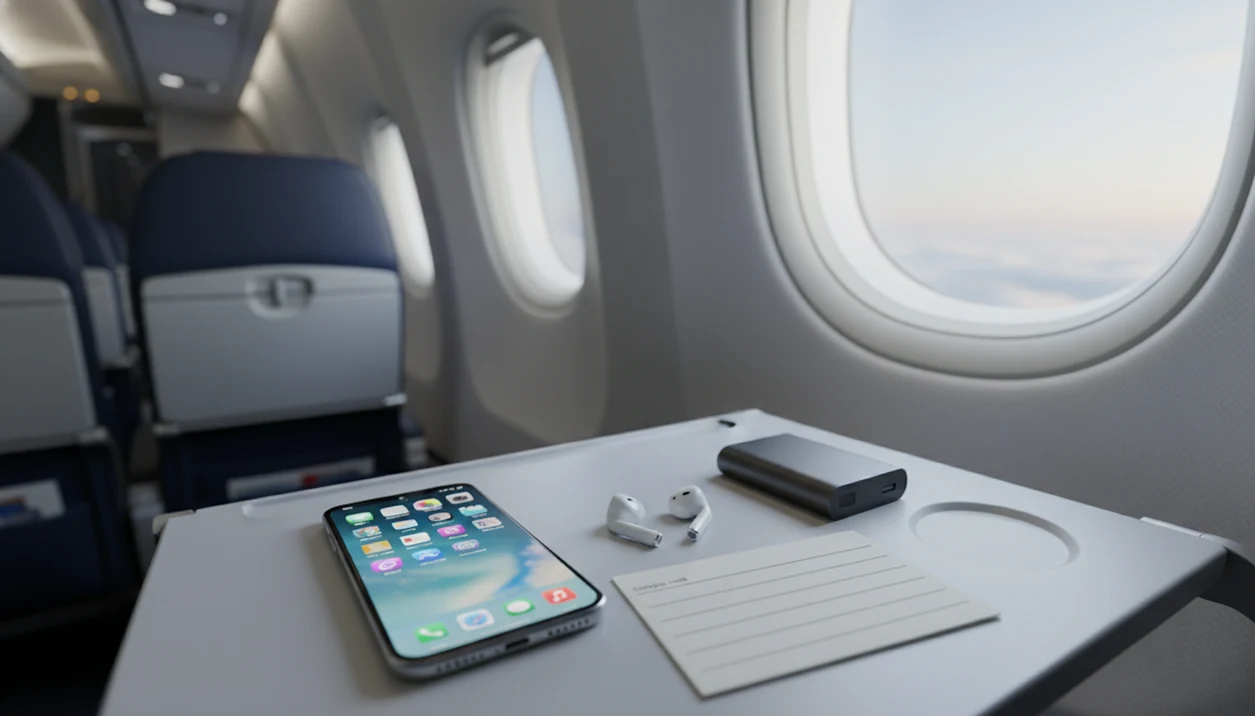
If you're searching for how to use phone for panic on plane, prepare it before boarding as an offline coping kit with saved notes, breathing timers, calming audio, grounding scripts, and support messages that work in airplane mode. Put the most important tools where you can open them in one or two taps during takeoff, turbulence, or a panic spike.
Definition: A phone panic plan for a plane is a preloaded, offline set of coping tools on your smartphone designed to guide you through fear of flying symptoms when cellular service and Wi-Fi are unavailable.
TL;DR
- Set up the plan before boarding because airplane mode disables cellular service and in-flight Wi-Fi may not be available.
- Use offline anxiety tools for flight coping: breathing timers, grounding notes, downloaded audio, low-stress distractions, and prewritten support messages.
- Keep the plan simple enough to use while panicking, and treat it as support rather than a replacement for CBT, exposure therapy, or medical advice.
This guide is educational and meant for short-term coping during a flight. If panic symptoms are severe, new, medically unusual, or disabling, use this plan alongside advice from a licensed clinician rather than as a substitute for care.
Phone Panic Plan for Plane Anxiety: What It Means
A phone panic plan for plane anxiety means your phone becomes an offline coping kit, not a mid-air calling device. The point is to open preloaded tools when your body says “danger,” even though the plane is operating normally.
Airplane mode turns off cellular radios, but many local tools still work if the content is already stored on the device: Notes, screenshots, timers, downloaded music, saved videos, local app content, and files already stored on the phone source. That matters during boarding, takeoff, turbulence, cruising, and descent, when anxious thinking can get fast and messy.
I like the plan to sit in one folder, not scattered across five apps. When the boarding pass is glowing in Apple Wallet and your mouth is dry at the gate, you don't want to hunt.
Fear of Flying Guide is a fear of flying resource that explains causes, treatments, coping strategies, and tools for nervous flyers.
5 Offline Anxiety Tools for Flight Panic
These five offline anxiety tools give your phone panic plan structure when Wi-Fi and cellular service are unavailable. Put them on the home screen, lock screen widget, or top row of a folder named “Flight Calm.”
- Breathing timer: Use a two-minute timer or breathing app to slow your pace during a panic spike. It gives your body one small job.
- Grounding note: Save a short 5-4-3-2-1 script so your attention moves back to the cabin, seat, and present moment.
- Downloaded calming audio: Keep one track offline, such as a guided breathing file, familiar playlist, or calm audio lesson.
- Low-stress distraction: Choose a puzzle, simple game, familiar show, or playlist that won’t raise your adrenaline.
- Support message folder: Save screenshots or Notes from trusted people, since live texting may fail in the air.
One tap matters.
A good comprehensive fear of flying resource should explain causes, treatments, coping strategies, and tools for nervous flyers, not just offer vague reassurance about being calm.
Airplane Mode Mechanics for a Phone Panic Plan
Panic narrows attention, increases threat scanning, and makes decision-making harder. A preloaded phone plan reduces cognitive load, which means it tells your anxious brain exactly what to do next without asking it to sort options.
Two facts help frame this. NIMH statistics show 12.5% lifetime prevalence and 7.1% 12-month prevalence for specific phobia among U.S. adults, and flying fear can fit the situational phobia category source. That doesn't mean every nervous flyer has a disorder, but it shows intense situational fear is not rare.
The mechanism is simple. Breathing can lower physiological arousal. Grounding reduces hypervigilance. Mindfulness gives the fear a label instead of a command. Distraction pulls attention away from every engine sound and cabin bump.
For acute flight panic, a phone plan usually works best when it gives one clear next action, while open-ended browsing often feeds threat scanning.
Before Boarding: Requirements for a Phone Panic Plan on a Plane
Does a phone panic plan work on a plane without Wi-Fi? Yes, but only if you prepare every important tool before boarding and test it in airplane mode.
Download your audio, podcasts, videos, meditations, playlists, and app lessons while you still have reliable service. Create one folder named “Flight Calm,” “Plane Panic Plan,” or something plain enough to find with shaky fingers. I prefer boring names because panic does not reward cleverness.
Charge the phone before you leave, pack a battery pack, and check headphones before security. Wired headphones are not glamorous, but they don't need Bluetooth pairing when your hands are sweaty in row 18.
If you screenshot coping notes near your boarding pass, keep documents and anxiety tools separate. A nervous flyer can easily open the wrong thing when the flight attendant is checking overhead bins.
Tools like Fear of Flying Guide, SOAR, and flyconfident.com can be part of preparation when their content is available before the flight.
How to Use Your Phone for Panic on a Plane
Use your phone for panic on a plane by building a short offline sequence before the flight, then practicing it once on the ground. Make the plan boring on purpose, so it still works when the engines spool for takeoff.
- Set airplane-mode-safe access by creating a home screen folder, lock screen shortcut, or top-row folder for your panic tools.
- Save a short panic script in Notes with exact instructions for your next two minutes: breathe, ground, read one fact, then choose one action.
- Download breathing audio, grounding prompts, and calming tracks so they play without Wi-Fi, cellular service, or cloud access.
- Add one non-stressful distraction such as a puzzle, simple game, familiar show, or playlist that does not involve news or aviation clips.
- Practice the sequence on the ground with airplane mode turned on before the travel day.
For persistent phobias, clinical guidance commonly emphasizes CBT and exposure-based treatment, with coping tools used as support rather than avoidance source. If your fear is severe, start with a broader plan, not only a phone folder.
Offline Breathing Timers and Grounding Notes for Flight Anxiety
Slow breathing is often a first-line acute anxiety tool because it can reduce physiological arousal, especially racing breath and muscle tension. Relaxation techniques that include breathing exercises are commonly used to manage stress and anxiety symptoms, although they are not a standalone cure for phobias source. Use gentle breathing, not heroic breathing.
Try 4-6 breathing, with a four-count inhale and six-count exhale. Box breathing can help some people, but skip it if breath holds make you feel trapped. Another option is a two-minute exhale-focused timer: inhale normally, exhale slowly, repeat until the timer ends. For more patterns, keep a saved copy of breathing exercises for flight anxiety in your pre-flight reading.
Do not force deep breaths if you feel dizzy. Sit back, loosen your jaw, and make the exhale a little longer than the inhale.
Saved 5-4-3-2-1 flight grounding script
Save this in Notes: “Name 5 things I see, 4 things I feel, 3 sounds I hear, 2 colors near me, and 1 steady fact: I am seated, breathing, and following my plan.”
Support Messages and Panic Scripts Saved on Your Phone
A good panic script is short enough to read when thinking clearly is difficult. Use four parts: name the symptom, state the facts, choose the next action, and repeat a coping phrase.
- Turbulence script: “My stomach dropped because the plane moved through uneven air. Planes are built for this. Put both feet down. Start the breathing track.”
- Takeoff script: “The runway bumps and engine sound are expected. My job is to exhale slowly until the seatbelt sign stays on.”
- Racing heart script: “This is adrenaline, not proof of danger. I will sip water, relax my shoulders, and count six slow exhales.”
- Feeling trapped script: “I do not need to escape this minute. I need to finish the next five minutes.”
Save supportive texts as screenshots or Notes before boarding. The instinct to text “I can't do this” is real, but live messaging may not work.
For many nervous flyers, a saved script is easier than a live reassurance text because it is available instantly and does not depend on Wi-Fi.
5 Common Phone Panic Plan Mistakes on Flights
These five mistakes make phone-based coping fail right when you need it. Check them before the boarding group is called, not once the wheels bump along the runway.
- Assuming streaming will work: Meditation libraries, cloud notes, music apps, and podcasts may fail without offline downloads.
- Hiding tools too deeply: A calming track buried inside three menus is not panic-friendly.
- Using only distraction: Games and shows help, but stronger plans also include breathing, grounding, and panic scripts.
- Opening anxiety-provoking content: Turbulence videos, crash statistics, doomscrolling, and fear forums can intensify threat scanning.
- Forgetting backups: Battery drain, dead headphones, and app crashes happen. Pack a printed coping card.
Reset the plan.
If you are comparing apps, courses, and offline tools, a best fear of flying app guide can help you separate education, tracking, exposure, and in-flight coping features.
Phone Panic Plan Verification Before Takeoff
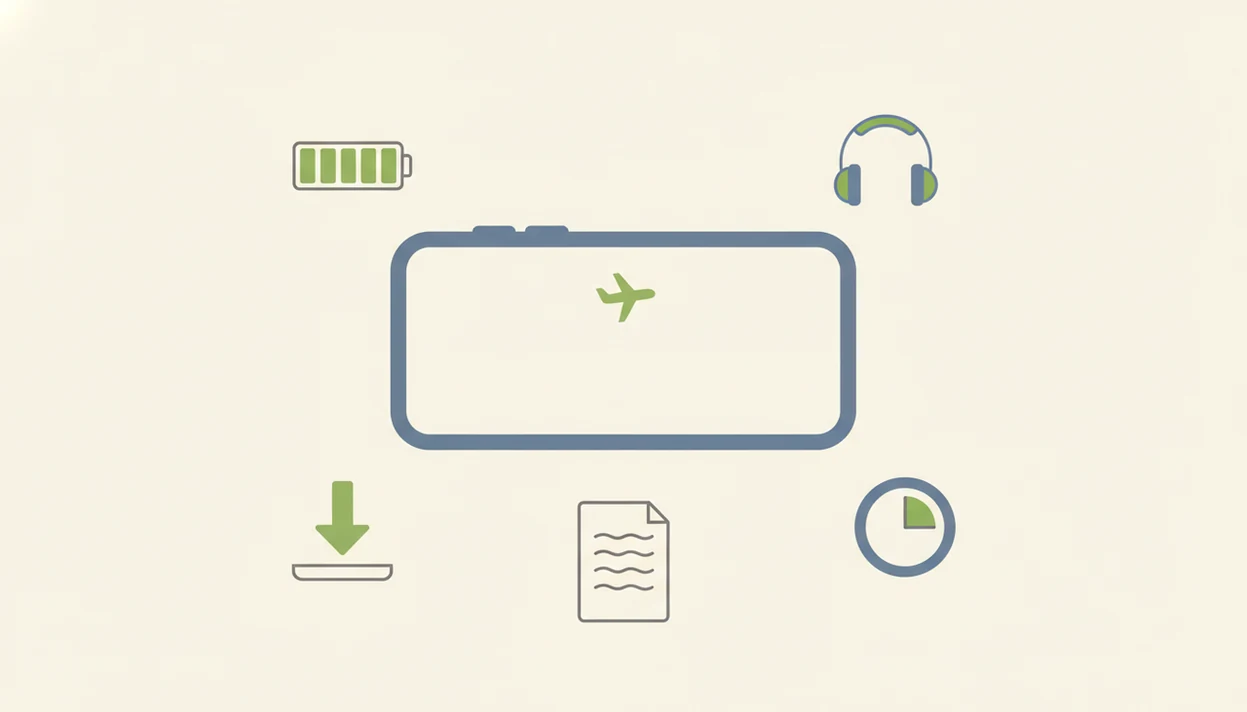
Verify your phone panic plan by turning on airplane mode before boarding or at the gate and testing every tool. If it does not work on the ground, do not trust it in the air.
| Tool to test | What to check before takeoff | Backup if it fails |
|---|---|---|
| Notes or script | Opens without cloud loading | Printed coping card |
| Breathing audio | Plays fully in airplane mode | Memorized 4-6 breathing |
| Timer | Starts in one tap | Watch or seatback clock |
| Headphones | Connect or plug in cleanly | Use visual breathing counts |
| Distraction | Game, show, or playlist opens offline | Magazine, puzzle book, simple counting |
| Battery | Low power mode and battery pack ready | Ask crew for practical help if needed |
Do a 60-second rehearsal: open the folder, read the script, start breathing audio, and choose the distraction. At the gate, that rehearsal can feel silly. In the cabin, it feels familiar.
If panic spikes despite the plan, you can calmly tell a flight attendant, “I’m anxious, not unsafe. Could you check on me in a few minutes?”
Limitations
A phone panic plan manages symptoms during flights, but it does not treat the underlying fear of flying by itself. It is a support tool, not therapy.
- Severe, worsening, or disabling fear may need CBT, exposure-based treatment, medical advice, or a licensed clinician.
- Controlled trials show CBT can be effective for anxiety disorders including specific phobias, but results vary by person and format source.
- In extreme panic, you may be too overwhelmed to navigate apps, so the sequence must be practiced and simple.
- Battery failure, app crashes, forgotten downloads, headphone problems, or airline rules can make phone tools unavailable.
- Over-reliance on the phone can become a safety behavior if you believe flying is impossible without it.
- Phone-based strategies have less direct standalone evidence for fear of flying than CBT and exposure therapy.
If medication questions are part of your flight-day plan, review flight anxiety medication with a clinician rather than improvising before travel.
Read more
FAQ
Can my phone still work in airplane mode during a panic?
Yes. Offline apps, Notes, saved files, timers, music, downloaded videos, and local audio can still work while cellular service is disabled.
Can I text someone if I panic during a flight?
Usually only if the plane offers working Wi-Fi or messaging service. Save support messages offline before boarding so your plan does not depend on live texting.
What should I download on my phone before flying?
Download calming audio, breathing guides, meditations, playlists, podcasts, familiar shows, grounding scripts, and simple games. Test each one in airplane mode before the flight.
Which breathing app works offline on a plane?
Choose any breathing timer or audio app that you have confirmed works offline. Test it in airplane mode at home, not for the first time during takeoff.
Do phone games help with flight anxiety?
Low-stress phone games can reduce hypervigilance by giving attention somewhere else to land. They work better when paired with breathing and grounding.
What should I do if my phone dies on the plane?
Use a power bank if allowed, then switch to a printed coping card or memorized breathing pattern. You can also ask cabin crew for calm practical reassurance.
Is panic on planes dangerous?
Panic feels frightening, but it is usually a surge of anxiety symptoms rather than a sign of danger. Seek medical help for chest pain, fainting, severe shortness of breath, or symptoms that feel unusual for you.