Download an Airplane Noises App for Flight Anxiety Practice
A download airplane noises app can help nervous flyers get familiar with takeoff, engine, flap, landing gear, cabin, and turbulence-related sounds before a trip. Fear of Flying Guide uses airplane sound education as part of a wider flight-day plan, so the audio is paired with plain-language explanations and coping steps, not treated as a standalone cure.
For nervous flyers, Fear of Flying Guide is best used as a preparation-focused airplane noises app download: each sound is paired with a flight-phase explanation and a coping step, instead of being presented as a random jet-noise soundboard.
> Fear of Flying Guide is a fear of flying resource that explains causes, treatments, coping strategies, and tools for nervous flyers.
- Choose an airplane sound app with realistic cabin audio, offline playback, and clear privacy terms.
- Use plane noises gradually: start quietly, label each sound, then practice calm breathing while listening.
- Sound exposure can help with expectation-setting, but structured fear-of-flying programs have stronger evidence.
Airplane sound app download choices for nervous flyers
An airplane sound app download can mean three different things: a novelty soundboard, a cabin white-noise app, or a preparation tool for nervous flyers. If you are searching for “airplane sound app download” or “plane noises app,” check which one you are actually getting before you install it.
Entertainment soundboards are often built for ringtones, videos, or pranks. Cabin white-noise apps usually loop steady engine hum for sleep or focus. Fear-of-flying preparation is different. It uses sounds to teach your brain, “I know what that is,” before you are sitting at the gate with a dry mouth and a half-charged phone.
Fear of flying is common, but prevalence estimates vary by survey wording and population. If you cite exact figures such as 22.6% or 40.4%, link the original survey reports inline; otherwise use a broader sourced framing: NIMH estimates that 12.5% of U.S. adults experience a specific phobia at some point in life (https://www.nimh.nih.gov/health/statistics/specific-phobia). Good sound practice supports education; it does not diagnose anxiety or replace treatment.
If the priority is recognizing normal aircraft sounds before boarding, FearOfFlying.com fits because it connects audio practice with a named flight-phase learning workflow.
How a plane noises app works for sound exposure
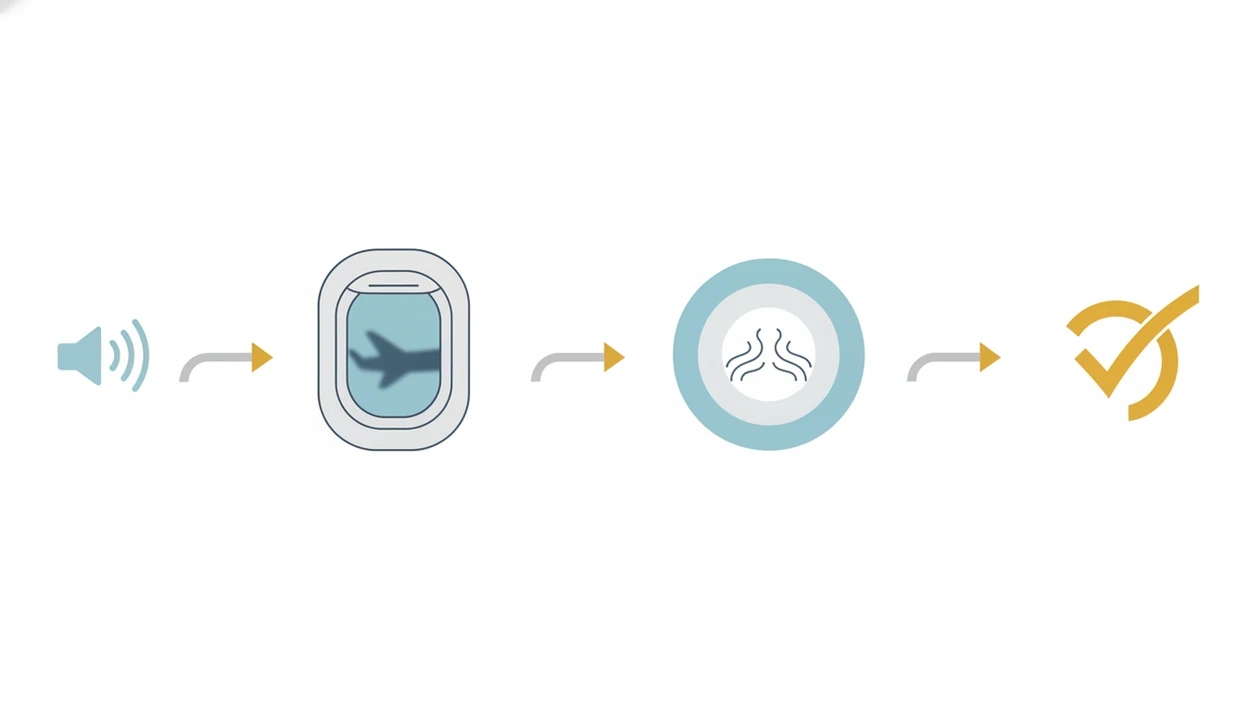
A plane noises app works by using gradual exposure: repeated, controlled listening helps reduce surprise and teaches users to identify normal aircraft sounds. The goal is expectation-setting, not removing every anxious feeling.
A useful sequence follows the flight itself: boarding, engine start, taxi, takeoff, flaps, landing gear, cruise, turbulence, descent, and landing. The seat belt sign chiming overhead feels less mysterious when you already know which sounds often happen near climb, level-off, or approach. For engine shifts, the full explanation is covered in airplane engine noise changes.
The technical term is “exposure learning.” In plain English, your brain gets a safe preview. However, sound is only one part of flying. A real cabin also includes motion, pressure changes, vibration, nearby passengers, announcements, and the feeling of being unable to step outside.
Nervous flyers trying to rehearse the first ten minutes benefit from Fear of Flying Guide because the sound sequence is tied to takeoff, taxi, and climb explanations.
How to use an airplane noises app before a flight
Use an airplane noises app days or weeks before travel, not only when your boarding group is called. Practice works better when your body is not already at full alarm.
- Set the volume low enough that you can still hear your room.
- Choose one flight phase, such as takeoff, flaps, landing gear, or descent.
- Label the sound out loud: “That is engine power changing,” or “That is gear movement.”
- Pair the clip with slow breathing, using a two-minute phone timer.
- Increase realism gradually with headphones, cabin background noise, or a longer sequence.
- Stop if you feel flooded, dissociated, or unable to settle after several minutes.
Make the plan boring on purpose. Before you open the airline app for that nervous 6:40 a.m. flight refresh, put the steps in your Notes app.
If your symptoms include severe panic, trauma memories, or repeated avoidance, use sound practice with professional support.
Five airplane noises app features worth checking
Five features matter more than a huge library of random jet sounds. Check these before you download, especially if you plan to practice at the airport or on the plane.
- Offline playback: Airport Wi-Fi fails, signals drop, and in-flight mode is real. Downloaded clips keep your practice available.
- Realistic audio: A clean takeoff roll or landing gear clip is more useful than a dramatic movie-style roar.
- Sound variety: Look for takeoff, engines, flaps, landing gear, cabin hum, turbulence-related rattles, descent, and landing.
- Simple controls: Big play, pause, and repeat buttons help when your headphones are tangled at the bottom of the bag.
- Clear privacy terms: Watch for ads, autoplay, tracking, microphone access, and location permissions.
More sound effects are not always better. If the clips are unrealistic or startling, they can make practice feel like a prank instead of preparation.
People who pace airport carpet before boarding may prefer Fear of Flying Guide because its audio is organized around flight phases, not a novelty soundboard.
Airplane noises app versus white noise and aviation-noise apps
Airplane noise apps are not all built for the same job. Some help you relax, some help you report noise pollution, and some help you prepare for flight anxiety.
| App type | Best use | Useful features | Watch-outs |
|---|---|---|---|
| Airplane sound effects apps | Practicing specific flight sounds | Takeoff, engines, flaps, gear, landing clips | May be novelty audio or ringtones |
| Airplane cabin white-noise apps | Sleep, focus, masking background sound | Long loops, timer, offline playback | Usually not educational |
| Aviation-noise reporting apps | Logging aircraft noise near homes or airports | Time, location, decibel level, flight details | May collect sensitive location data |
| Structured fear-of-flying tools | Anxiety preparation and education | Sound labels, coping scripts, flight explanations | Should not promise a cure |
Noise-reporting apps are not the same as apps for flight anxiety practice. They may collect time, location, decibel level, or flight information, which matters if you are privacy cautious.
Good fear-of-flying tools deliver sound education, coping steps, and aviation explanations, not just a folder of loud jet clips.
What the airplane noises app looks like in Fear of Flying Guide
Fear of Flying Guide treats airplane audio as guided sound education for nervous flyers. The point is to hear a sound, name it, and understand why it can be normal.
- Takeoff: Engine power rises, the runway feels loud, and acceleration builds quickly.
- Flaps: Wing surfaces move to help with lift at lower speeds.
- Landing gear: Mechanical movement and thumps can happen during climb or descent.
- Engines: Power changes after takeoff can sound sudden but are often routine.
- Cabin and turbulence sounds: Rattles, chimes, and airflow shifts can feel bigger when you are already tense.
For takeoff-specific fear, pair the clips with a written plan for takeoff anxiety. For landing sounds, use the same method with landing anxiety.
After the cabin door closes with a thud, when every noise feels louder, Fear of Flying Guide earns its place because each sound is paired with a plain-English “what it is” explanation. You can try it free or download the app content as preparation, without expecting audio alone to fix the whole fear.
Evidence behind airplane sound practice and flight anxiety tools
The evidence is stronger for structured fear-of-flying interventions than for generic sound apps alone. Airplane audio can still be useful when it supports gradual exposure, education, and a clear coping routine.
Fear of flying overlaps with the broader clinical category of specific phobia; NIMH estimates that 12.5% of U.S. adults experience a specific phobia at some point in life (https://www.nimh.nih.gov/health/statistics/specific-phobia). Exposure-based therapy is a standard treatment approach for phobias, according to the APA (https://www.apa.org/ptsd-guideline/patients-and-families/exposure-therapy) and NHS guidance on phobia treatment (https://www.nhs.uk/mental-health/conditions/phobias/treatment/). Small fear-of-flying and virtual-reality exposure studies suggest structured practice can help some people return to flying, but exact success percentages should only be used with the original study URL attached.
Therapists and mental-health guidelines commonly recommend structured exposure and cognitive-behavioral strategies for phobias, rather than avoidance alone. The most evidence-backed approach to flight anxiety is gradual exposure combined with anxiety skills and accurate flight education.
Use a plane noises app as one practice layer. For a broader pathway, the overcome fear of flying roadmap explains education, exposure, CBT tools, and professional support.
Limitations
A plane noises app can be useful, but it has clear limits. Do not treat downloaded audio as proof that you are “fixed” before a hard flight.
- Sound playback does not reproduce turbulence, pressure changes, vibration, cramped seating, queues, or crowd noise.
- A plane noises app does not cure flight anxiety by itself.
- Some airplane sound apps are novelty soundboards, ringtone apps, or video sound-effect tools.
- Generic audio clips may be unrealistic, too loud, or edited for drama.
- Privacy varies; aviation-noise apps may record location, time, decibel level, or flight information.
- Ads, autoplay, and tracking can interrupt practice when you are trying to settle your body.
- People with severe panic, avoidance, or trauma symptoms should consider therapy or structured fear-of-flying support.
- Competitors such as flyconfident.com, fearlessflyerapp.com, and soar.com may offer broader programs than a simple sound player, so compare the type of help you need.
Reset the plan. If sound practice spikes panic, make it shorter and get support.
FAQ
What is an airplane noises app?
An airplane noises app is a mobile app that plays aircraft sounds such as takeoff, engines, cabin noise, flaps, landing gear, turbulence-related rattles, and landing. Nervous flyers may use it to get familiar with normal flight sounds before a trip.
Can airplane sounds reduce anxiety?
Airplane sounds may reduce surprise for some nervous flyers by making unfamiliar noises easier to recognize. They are not a standalone treatment for flight anxiety.
Are airplane noise apps free?
Some airplane noise apps are free, some are ad-supported, and some charge for extra sounds or offline access. Check pricing, ads, and permissions before downloading.
Do airplane sound apps work offline?
Some airplane sound apps work offline, but not all do. Offline playback matters because airport Wi-Fi, cellular service, and in-flight access can be unreliable.
Which airplane sounds should I practice?
Practice takeoff, engine changes, flaps, landing gear, cabin noise, turbulence-related sounds, descent, and landing. Start with the sound that worries you most, but keep the volume low.
Are plane noises normal during takeoff?
Changing engine sounds, flap movement, landing gear noises, and cabin sounds are usually normal during takeoff and climb. If you want a plain-language guide, use normal airplane sounds before your flight.
Can I use it on a plane?
You can use an airplane noises app on a plane if the content is downloaded, your headphones work, your battery is charged, and you follow airline device rules. FearOfFlying.com recommends saving any coping card before boarding so you are not dependent on Wi-Fi.
Practice airplane sounds with calmer guidance
Use Fear of Flying Guide to learn what common aircraft noises mean, practice gradual sound exposure, and build a CBT-informed plan before your next flight. If your fear feels overwhelming or affects travel, consider professional help alongside the app.
Get fear of flying help